
Isonade: The Tail That Comes Up Beside the Boat
磯撫で(いそなで) Isonade ASCII: Isonade
Also known as: 磯撫
Pronunciation: ee-soh-nah-deh
An 1841 illustrated collection describes a shark-like creature in the western sea that attacks with its tail — and a 1960 record from Kumano shows the name still doing work as an explanation for deaths at the shore.
Quick Facts
- Habitat
- Sea, Coast, Ship
- Region
- the western sea, Kumano (Mie)
- Recorded period
- Ehon Hyaku Monogatari (1841), Kumano record (1960)
- Nature
- Harmful
- Danger rating
The danger rating is an editorial summary made for readability. It is not an objective measure found in folklore sources.
Watch the Short
What is Isonade?
Isonade means, roughly, “the shore-stroking” — from iso, the rocky coastline, and a verb for brushing a hand across something. It is a gentle word. It is attached to the least gentle thing on this coast.
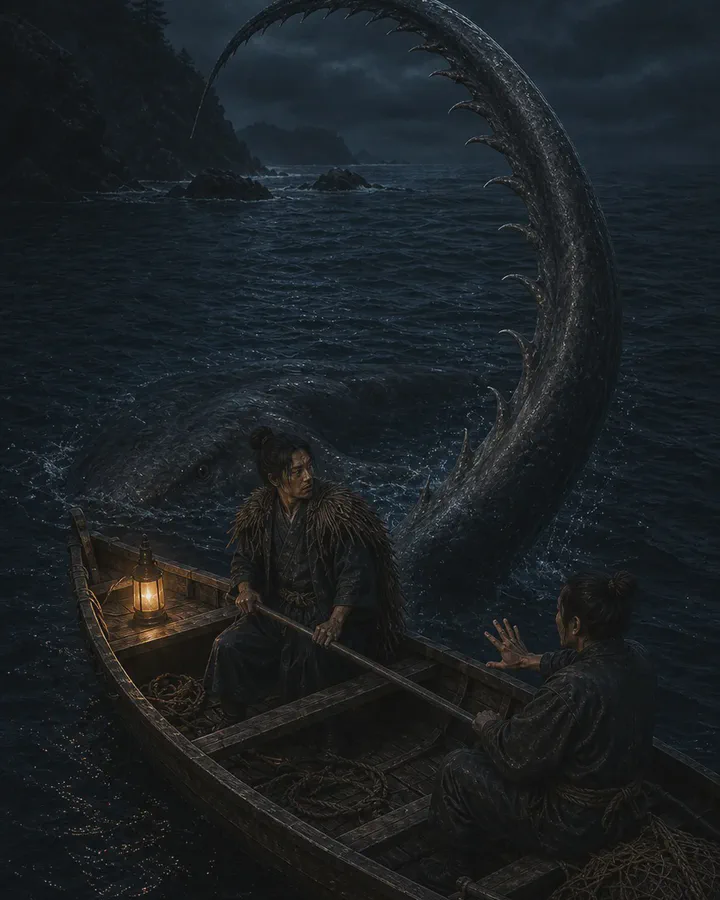
The account comes from Ehon Hyaku Monogatari, an illustrated collection printed in 1841. It places Isonade in the western sea and describes something that looks like a shark but does not attack the way a shark does. It attacks with its tail: raising it beside a boat, sweeping a person off the deck into the water, and taking them.
The illustration adds the detail that makes the thing memorable. The tail is lined with hooks.
Appearance
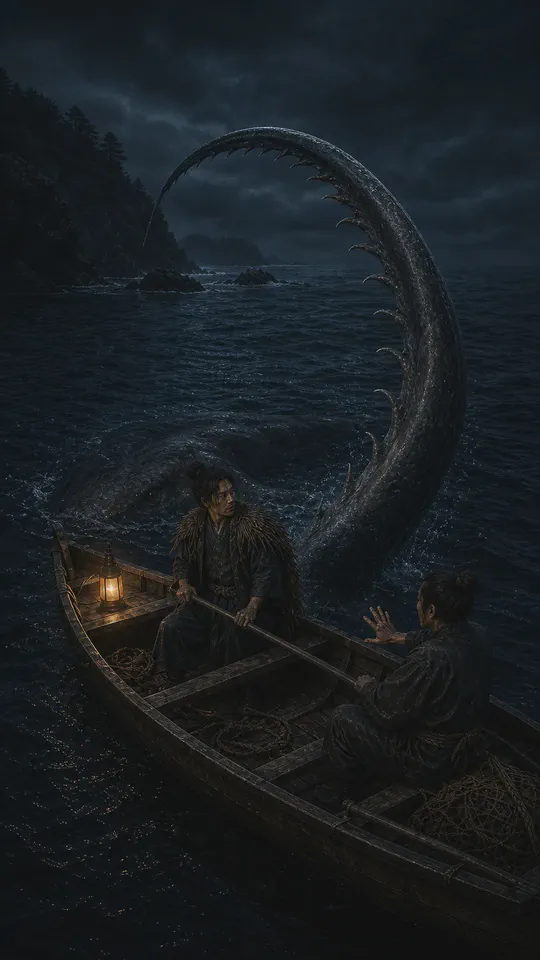
Our illustration follows the 1841 account: a large shark-like body barely visible under the surface, and one enormous curved tail out of the water beside the boat, hooked along its inner edge. The scale of the tail is a choice made for the screen. The shark resemblance and the long hooked tail come from the source.
Nothing about it is designed to be seen in time. In the picture the men have already been found.
Behavior and abilities
- It attacks with the tail. The mouth plays no part in the account. The tail reaches over the side.
- It works in calm water. There is no warning in the sea state — the danger arrives without the weather changing.
- It takes a person off a boat. One sweep, into the water.
- It is not seen first. The order of events in the account is that the tail comes up, and then people understand what is happening.
The 1841 tale and the 1960 shore
More than a century after the illustrated collection, the name was still in use. A record collected in 1960 at Kumano in Mie describes Isonade as a shark with a long tail that struck with it at the shore’s edge — and, more tellingly, preserves a phrase. When someone died by the sea, people said Isonade must have brushed them.
These are not the same story, and the Kumano material is not a later sighting of the 1841 creature. They are two different jobs done by one name. The 1841 version is a monster in a book of monsters, with a body and an illustration. The 1960 version is a thing you say when a death has already happened and there is nothing else to say.
The verb in the name is what carries across. Not seized, not devoured. Brushed — as though what took the person did it in passing, on the way to somewhere else, without any particular interest in them.
Weaknesses and countermeasures
None is recorded, and this one is not an oversight in the sources. It follows from what the creature is.
Every part of the account is about the interval before anyone knows. The sea is calm, the boat is where it should be, and the first information anyone gets is the tail already coming up. There is no stage at which a person is supposed to do something, because by the point they could, it is finished.
Documented records and later imagery
Documented records. A shark-like creature of the western sea in the 1841 Ehon Hyaku Monogatari, attacking with a hooked tail raised beside a boat to sweep a person into the water; and a 1960 record from Kumano in Mie recalling a long-tailed shark that struck at the shore, together with the saying used when someone died by the sea.
Later imagery. Modern versions push Isonade toward the giant sea monster — more mass, more teeth, more of the creature above the waterline, closer to a film than to a woodblock. The 1841 image had almost nothing above the waterline, which was the point. What the fishermen of Kumano meant by the word was not a beast that arrives. It was the sea taking someone quietly, and a name for the fact that it does.
Sources and further reading
- Library Ehon Hyaku Monogatari (絵本百物語), 1841 (external link) National Diet Library Search The illustrated collection carrying the Isonade account of a shark-like creature in the western sea that attacks with its tail.
- Museum Isonade illustration from Ehon Hyaku Monogatari (external link) Wikimedia Commons The 1841 woodblock image, showing the raised tail and its row of hooks.
- Fieldwork collection Isonade entry (external link) International Research Center for Japanese Studies A 1960 record from Kumano, Mie, describing Isonade as a long-tailed shark that strikes with its tail at the shore, and the saying used when someone died by the sea.
Related yokai
Funayūrei
船幽霊(ふなゆうれい)
A ruined boat draws alongside at night and its crew asks for a scoop. Give them an ordinary one, and they may use it to fill your boat with seawater.

Iso-onna
磯女(いそおんな)
A 1929 record from Mizuho in Nagasaki describes a wrestler who tried to speak to a black-haired woman sitting on a shore stone at night — and other accounts from the same coastline describe something else entirely under the same name.