
Iso-onna: The Woman on the Rock
磯女(いそおんな) Iso-onna ASCII: Iso-onna
Also known as: 海姫様
Pronunciation: ee-soh ohn-nah
A 1929 record from Mizuho in Nagasaki describes a wrestler who tried to speak to a black-haired woman sitting on a shore stone at night — and other accounts from the same coastline describe something else entirely under the same name.
Quick Facts
- Habitat
- Coast, Sea, Ship
- Region
- Mizuho (now Unzen, Nagasaki), Gotō, Ojika Island
- Recorded period
- Tabi to Densetsu (1929), Gotō record (1932), Ojika Island survey (1963)
- Nature
- Harmful
- Danger rating
The danger rating is an editorial summary made for readability. It is not an objective measure found in folklore sources.
Watch the Short
What is Iso-onna?
Iso is the rocky shore where the sea meets the land — not a beach, but the stony edge people cross to get somewhere. Iso-onna is the woman who is already sitting there when you arrive.
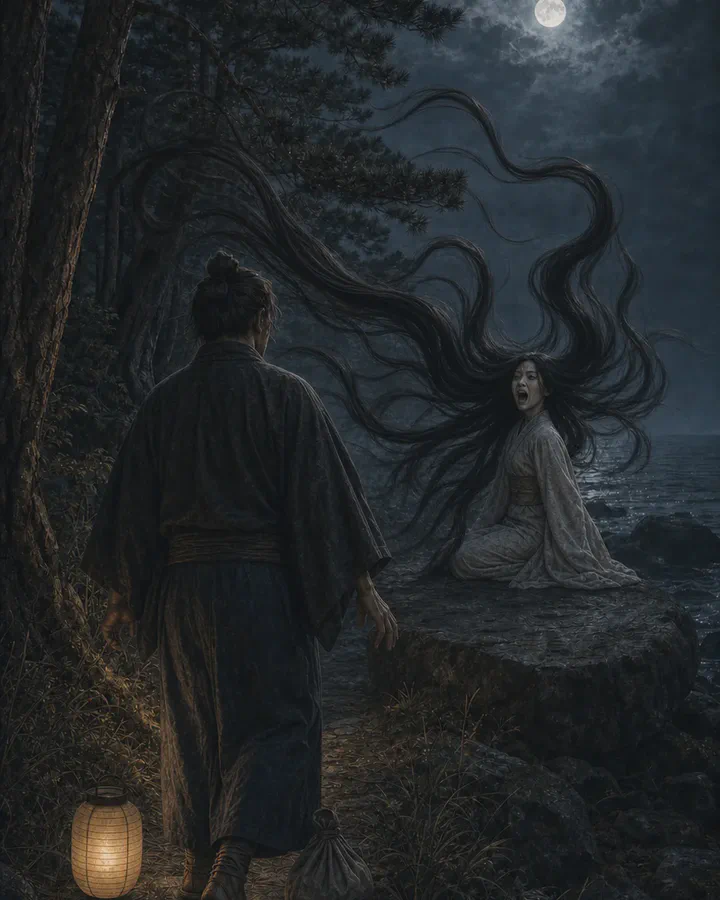
The account this episode follows was published in 1929 in the folklore periodical Tabi to Densetsu, from Mizuho in Nagasaki, in what is now Unzen. A wrestler is crossing a pine shore at night. A beautiful woman is seated on a stone with her long black hair hanging down. He goes to speak to her.
She cries out. The man is left rigid, unable to move. The record says her black hair drew out his blood, and that he died the following day.
Appearance
In the 1929 record she is a woman on a rock with very long black hair, and that is the whole description. She is not deformed, not obviously dead, not hiding anything. The horror arrives entirely through what happens next, which is a sound.
Elsewhere the body changes. A 1932 record from Gotō describes her as human from the chest up and trailing away like a ghost below, attacking boats. A 1963 survey on Ojika Island gives her a different nature again, discussed below.
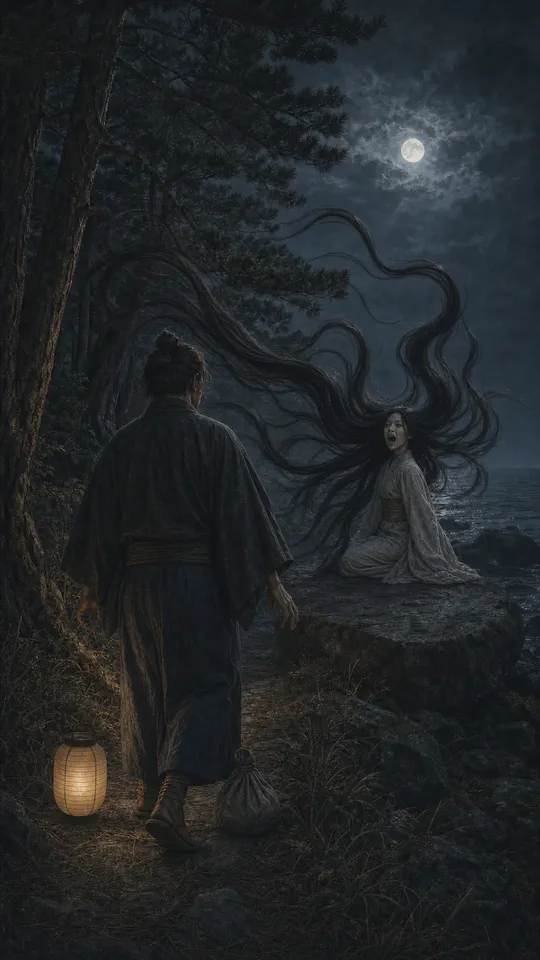
Our illustration stays with the 1929 encounter: the pines, the flat stone, the cry, and the hair. What the record says her hair did is left to the record.
Behavior and abilities
- She waits in plain sight. No lure, no disguise, no calling out. She is simply there, and the traveler is the one who approaches.
- She cries out. The scream is the weapon in the Mizuho account. Everything that follows depends on the man being unable to move.
- Her hair acts. The record attributes the harm to the hair, not to hands or teeth.
- She does not pursue. Nothing in the account has her leave the stone.
Three coastlines, three creatures
Within a small stretch of the Nagasaki coast, three collected records give three incompatible Iso-onna.
The 1929 Mizuho account is the encounter above: a woman on land, a scream, a death the next day. The 1932 Gotō account is a half-formed thing that comes at boats from the water. And the 1963 Ojika Island survey identifies Iso-onna with Umihime-sama and says plainly what she is — one of the drowned. She appears on calm days, in the form of a woman, and asks boatmen to carry the souls in the water back to shore.
That third record changes the shape of the whole entry. It is not a monster story. It is what a fishing community says about the people the sea kept, and the request it puts in their mouth is to be brought home.
Set the three side by side and no single creature emerges. What emerges is a coastline where people died, and a name that attached itself to more than one way of thinking about it.
Weaknesses and countermeasures
None is recorded. In the Mizuho account the wrestler is a large and capable man, and none of that matters, because the encounter is decided before he can act — he is stopped by the sound, and the rest happens to someone who cannot move.
The Ojika Island material is the closest thing to a countermeasure in the sources, and it is not defensive. It is a request that can be granted.
Documented records and later imagery
Documented records. A black-haired woman seated on a stone at Mizuho in 1929 whose cry left a wrestler rigid, with the record giving his death the next day; a half-human, half-ghostly figure attacking boats off Gotō in 1932; and an Ojika Island identification in 1963 of Iso-onna with Umihime-sama and with the drowned, appearing on calm days to ask that souls be carried ashore.
Later imagery. Modern collections tend to keep the hair and discard the rest, producing a fixed predator — long-haired, blood-draining, closer to a vampire with a coastal address. The 1963 record has no place in that version, which is a loss, because it is the one that explains why anybody was telling these stories. The shore is where people did not come back from. The woman sitting on the rock is what that fact looked like when it was given a face.
Sources and further reading
- Fieldwork collection Iso-onna, Mizuho, Nagasaki, from Tabi to Densetsu (1929) (external link) International Research Center for Japanese Studies A wrestler crossing a pine shore at night meets a black-haired woman seated on a stone. She cries out, he is left rigid, her hair is said to draw his blood, and he dies the following day.
- Fieldwork collection Funayūrei, Umi-bōzu, Iso-onna, Gotō (1932) (external link) International Research Center for Japanese Studies Human above the chest, trailing away like a ghost below, and attacking boats. A different creature under the same name.
- Fieldwork collection Iso-onna and Umihime-sama, Ojika Island (1963) (external link) International Research Center for Japanese Studies Identifies Iso-onna with Umihime-sama and with the drowned. She appears on calm days and asks boatmen to carry souls back to shore.
- Database Iso-onna entries by region (external link) International Research Center for Japanese Studies Nationwide result set for the name.
- Library Tabi to Densetsu (旅と伝説) (external link) National Diet Library Search The folklore periodical carrying the 1929 Mizuho account, in volume 2 number 7.
Related yokai
Nure-onna
濡女(ぬれおんな)
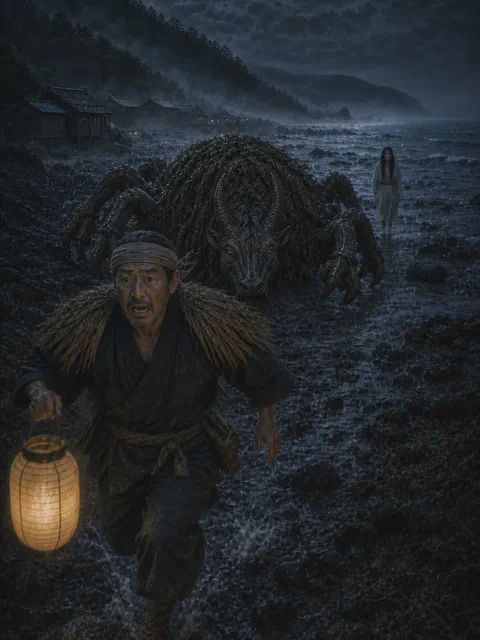
In a 1933 record from Iwami in Shimane, a fisherman walking home at night is given an infant by a wet-haired woman — and when he throws the bundle down and runs, something else comes out of the dark after him.
Funayūrei
船幽霊(ふなゆうれい)
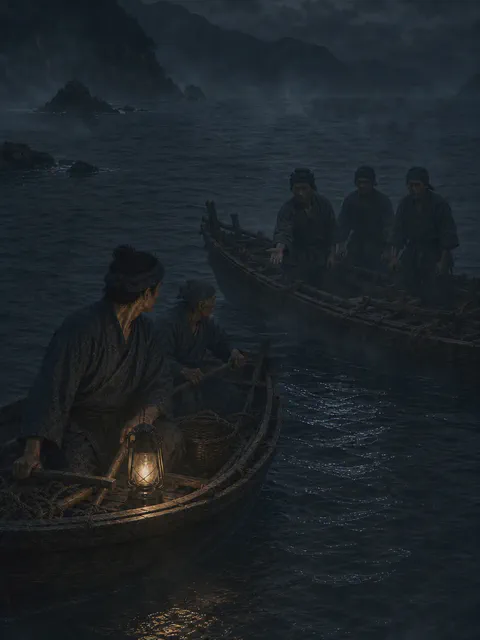
A ruined boat draws alongside at night and its crew asks for a scoop. Give them an ordinary one, and they may use it to fill your boat with seawater.