Ippon-datara: One Footprint, Then Another
一本だたら(いっぽんだたら) Ippon-datara ASCII: Ippon-datara
Also known as: 一つだたら
Pronunciation: eep-pon-DAH-tah-rah
In the Kii mountains a one-legged thing leaves enormous single tracks in the snow — and Yanagita Kunio, reporting them, declined to conclude a one-legged creature from footprints alone.
Quick Facts
- Habitat
- Mountain, Snow, Road
- Region
- the Kii mountains, including Kumano, the Hatenashi range and Obamine
- Recorded period
- Yanagita Kunio's Yama no Jinsei (1926), and local traditions collected since
- Nature
- Harmful
- Danger rating
The danger rating is an editorial summary made for readability. It is not an objective measure found in folklore sources.
Watch the Short
What is Ippon-datara?
Start with the evidence, because that is how this one actually reaches us.
In snow on a mountain in the Kii range, there is a footprint. Then, some distance ahead, another. Then another. They are enormous, and there is only ever one line of them.
Two feet make two lines. One line means one foot.
Ippon-datara — one-leg-datara — is the name for whatever left them.
What the sources agree and disagree on
Pull together the traditions of the Kii mountains, across Kumano, the Hatenashi range, Obamine and the villages between, and a shape emerges: a large body, one leg, and — sometimes — a single eye.
That “sometimes” is doing real work and this page keeps it. The single leg is shared almost everywhere the name appears. The single eye is not. Neither is the size, exactly, or what it does, or whether it does anything at all. Different valleys tell it differently, and there is no version that is the correct one.
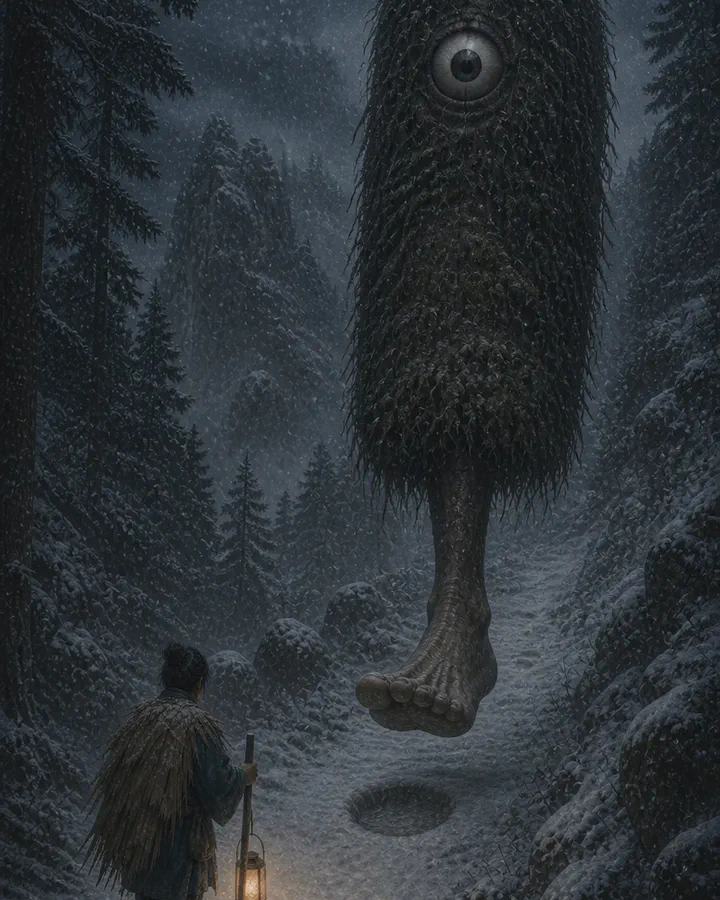
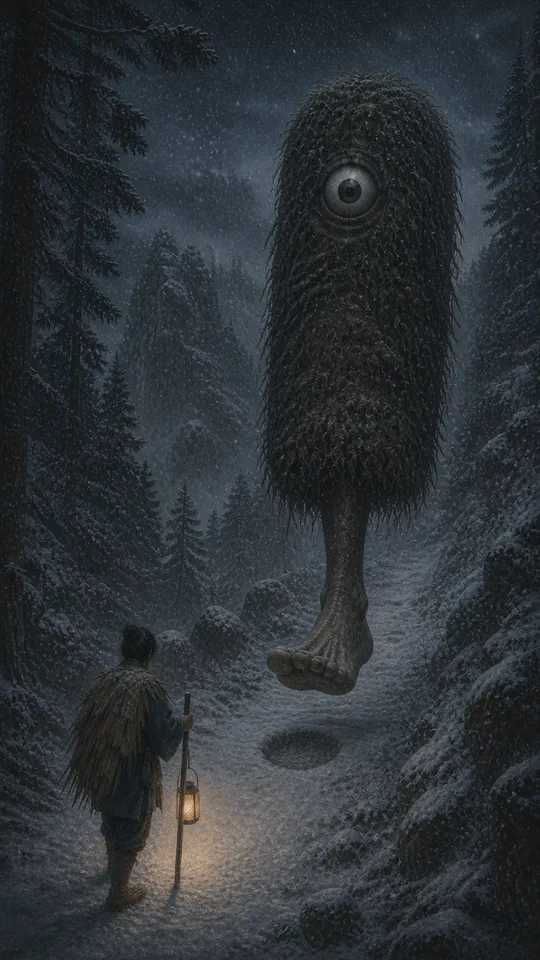
Our illustration follows the composite: a large one-legged shape at a distance, on a snow ridge, with the tracks running toward it.
The twentieth day
Some districts around the Hatenashi range and Obamine keep the twentieth day of the twelfth month as hate no hatsuka — a day when you do not go up the mountain.
The reason given varies, and the day itself is not observed identically across the Kii range, so this is a local practice rather than a regional law. But the structure of it is worth noticing: the tradition does not tell you how to survive an encounter. It tells you which day not to be there.
That is what people do about a danger they cannot fight.
Behavior and abilities
- It leaves tracks. This is the one thing every version has, and the only thing anyone reports actually seeing.
- It moves in snow. The prints are recorded in snow, which is where a single line of them is legible.
- It is large. Consistently, in every telling.
- What it does to people is unclear. The traditions differ, and several supply nothing at all.
Yanagita’s caution
Here is the part of this entry that deserves the most respect.
Yanagita Kunio discussed the Kumano ippon-datara in Yama no Jinsei in 1926, reporting what Minakata Kumagusu had told him about single enormous footprints found in snow. And having reported them, Yanagita declined to take the last step. He would not conclude a one-legged creature from footprints alone.
He was right to hesitate, and the hesitation is more interesting than the monster. A single line of prints in snow is a real observation that has an obvious explanation and several less obvious ones. What Yanagita is refusing is not the creature. It is the inference — the move from this is what I found to this is what made it.
That move is how a great many yokai came to exist, and it is rare to catch a folklorist standing at the edge of it and stopping.
Weaknesses and countermeasures
None is recorded, and the shape of the tradition explains why.
There is no confrontation to prepare for, because there is no reliable encounter. What survives is a date to stay home and a set of tracks. Nobody in this material fights an ippon-datara, escapes one, or is described as having met one face to face.
The precaution that exists is calendrical. Do not be on the mountain on that day.
Documented traditions and later imagery
Documented traditions. Across the Kii mountains, a one-legged thing of large size, sometimes given a single eye; enormous single footprints in snow, reported from Kumano by Minakata Kumagusu and relayed by Yanagita in 1926 with an explicit refusal to infer the creature from the tracks; and the twentieth day of the twelfth month kept in some districts as a day to stay off the mountain.
Later imagery. Modern versions have consolidated it: one leg, one eye, a fixed silhouette, often a stated origin in the tatara ironworkers whose trade was said to cost them an eye and a leg. That derivation is a proposal worth knowing about and is not established.
What the older material has instead is better. Somebody walked into fresh snow on a mountain, found a line of tracks that only went one way, and had to decide what to believe. Yanagita, given the same evidence, decided not to decide.
Sources and further reading
- Reliable secondary Yanagita Kunio, Yama no Jinsei (山の人生), 1926 Printed edition Reports the single enormous footprints in snow that Minakata Kumagusu described from Kumano, while declining to conclude a one-legged creature from footprints alone. Consulted in a printed edition; no stable public URL recorded.
- Reliable secondary Ippon-datara, Nara Yokai Shimbun Nara Prefecture Composite of southern Nara traditions: a large body, one leg, sometimes one eye, and the suggestion that mountain ascetics were mistaken for it.
- Reliable secondary Ippon-datara or Hitotsu-datara, Totsukawa Furusato Archive Takaragura no. 161 Totsukawa Village Local material from Kamikitayama and Obamine, including the twentieth day of the twelfth month as a day to stay off the mountain.
- Database Ippon-datara and Obamine no ippon-ashi entries (external link) International Research Center for Japanese Studies Single footprints in snow, and the Inozasa-ō variants.