Inugami: The Spirit No One Could Prove
犬神(いぬがみ) Inugami ASCII: Inugami
Also known as: Ingame
Pronunciation: ee-noo-gah-mee
A possessing spirit of western Japan with no agreed-upon body — and a label that excluded entire households from marriage and community life.
Quick Facts
- Habitat
- House, Mountain, Field
- Region
- Shikoku, Chūgoku, Kyushu
- Recorded period
- 1930s folklore records, 1976 field survey, postwar studies
- Nature
- Harmful
- Danger rating
The danger rating is an editorial summary made for readability. It is not an objective measure found in folklore sources.
Watch the Short
What is Inugami?
Inugami — “dog god” or “dog spirit,” recorded regionally under names such as ingame — is not a creature with a den and a diet. It is a belief about possession, documented across western Japan and especially strongly in Shikoku, along with parts of Chūgoku and Kyushu.
In the records, an inugami is said to attach itself to a person or animal. Illness, pain, and behavior that a community could not otherwise explain might be attributed to it. But the crucial fact about this tradition is not what the spirit was said to do to an individual. It is what the accusation did to families.
Appearance
The collected accounts do not agree. Some describe a dog. Others describe a mouse, or a snake. Others describe something only dimly visible, or nothing with a shape at all.
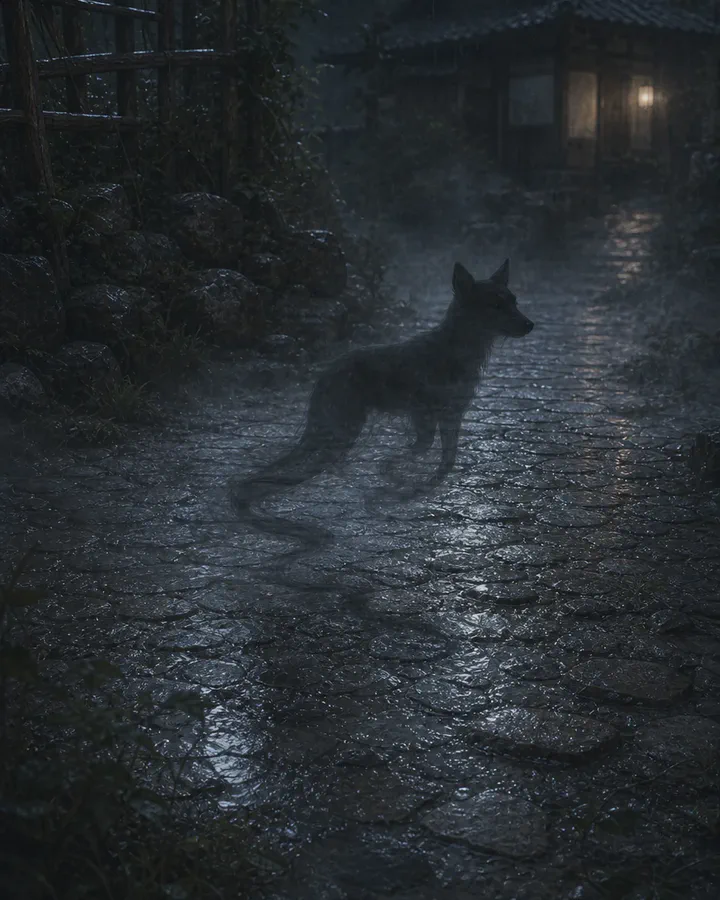
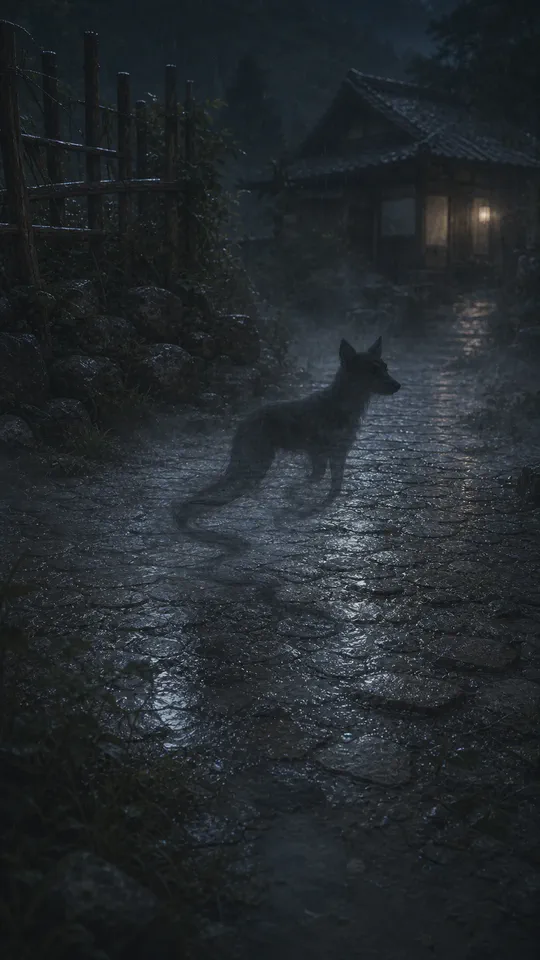
The disagreement is the point. A belief about an invisible cause does not need a fixed body, and never having one is what let it fit any misfortune that came along. Our illustration keeps that vagueness: what appears in the mist and on the paper screens is a doglike uncertainty rather than an animal you could point at.
Edo-period artists did draw the inugami, and those pictures are worth looking at — but they are one artist’s answer, made long after and far from the villages where the accounts were collected.
Behavior and abilities
- It possesses. The spirit is said to attach to a person or an animal.
- It explains misfortune. Sickness, distress, and sudden reversals could be attributed to it.
- It is inherited. In many records, the spirit is not attached to an individual but to a household, passing down through the family line.
That third point is what turns a possession belief into a social mechanism. Once the spirit is understood as hereditary, suspicion no longer targets a moment or a patient. It targets a lineage, permanently.
Folklore accounts and regional variations
Records from the 1930s in Tokushima and Kōchi, a 1976 survey in Hitoyoshi in Kumamoto, and postwar academic studies of Kōchi document both the belief and what it cost. Households known as inugami-suji — “inugami lineages” — were avoided by neighbors and, most consistently, shut out of marriage. Matches were refused. Engagements already agreed were broken off.
There was no way to argue with it. A family cannot produce the absence of a spirit, and a neighbor who has heard the rumor does not need evidence to act on it. The accusation outlived whoever started it, passing to children whose only involvement was being born in the house. Anthropologists working in Kōchi after the war traced how slowly it faded.
Weaknesses and countermeasures
The records describe rites and specialists consulted to lift a possession, rather than a weakness belonging to the spirit. But no ritual in these sources removes a reputation, and the reputation was the part that lasted. An exorcism could end an illness. Nothing ended the rumor.
Traditional folklore and later imagery
Documented tradition. A hereditary possession belief of western Japan in which an invisible spirit — variously described as a dog, a mouse, a snake, or nothing visible — was blamed for illness and misfortune, and in which whole households carried the label and faced exclusion from marriage and community life.
Later imagery. Modern horror fiction, film, and games have made the inugami into a concrete monster: a spectral dog with glowing eyes, summoned as a weapon, defeated in a confrontation. That version is dramatic and safe, because a monster can be fought. The recorded tradition offers no such ending. Its darkest element was never the spirit. It was what suspicion did to people who could not disprove it.
Sources and further reading
- Fieldwork collection Inugami / Ingame account, record 1340068 (external link) International Research Center for Japanese Studies A collected account of the possessing-spirit belief. Recorded forms differ widely; do not treat any one shape as the documented body.
- Fieldwork collection Comparable inugami records, similarity search 2360878 (external link) International Research Center for Japanese Studies Comparative set showing dog, mouse, snake and formless descriptions side by side.
- Fieldwork collection Records of inugami-suji households and marriage exclusion, similarity search 1070009 (external link) International Research Center for Japanese Studies Documents that whole households could be labelled and excluded from marriage. Present as recorded social discrimination against living people, never as a claim about any real family.
- Academic paper A study of change in "inugami" belief in postwar Kōchi Prefecture (external link) Japanese Society of Cultural Anthropology; J-STAGE Academic treatment of how the belief and its social effects changed after the war.
- Library Reference case on Shikoku inugami material (external link) National Diet Library Collaborative Reference Database Librarian-compiled bibliography of sources on the belief.
- Library Yokai drawn by Toriyama Sekien (external link) National Diet Library Image Bank Later visualizations; not evidence that collected accounts agreed on a shape.
Related yokai

Okuri-inu
送り犬(おくりいぬ)
A 1936 Gifu account describes a mountain dog that follows a traveler all the way to his door — and leaves only after salt and a word of thanks.
Bakeneko
化け猫(ばけねこ)
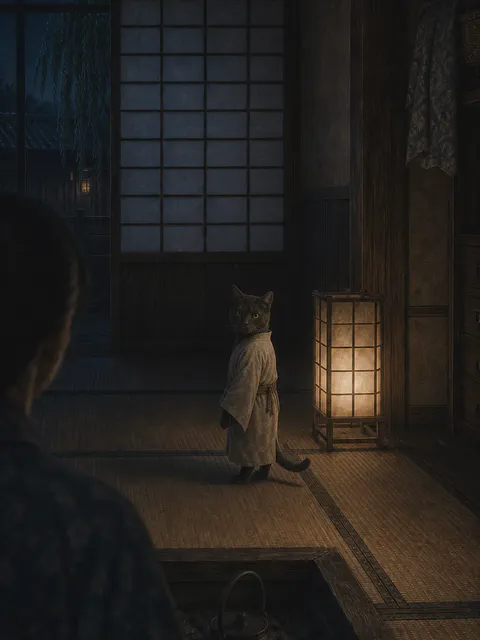
Stories of old cats that speak, perform, dress like people or take human form—and the separate cat yokai they keep getting confused with.