
Hihi: The Beast That Blinds Itself Laughing
狒々(ひひ) Hihi ASCII: Hihi
Pronunciation: HEE-hee
A 1712 Japanese encyclopedia compiled older Chinese descriptions of a black-haired, long-lipped creature that laughs when it sees a person — and whose upper lip then rolls up over its own eyes.
Quick Facts
- Habitat
- Mountain, Forest
- Region
- Mountains of the southwest, as given in the Chinese sources quoted by the encyclopedia
- Recorded period
- Wakan Sansai Zue (c. 1712), earlier Chinese descriptions quoted in the entry
- Nature
- Unknown
- Danger rating
The danger rating is an editorial summary made for readability. It is not an objective measure found in folklore sources.
Watch the Short
What is Hihi?
Hihi is the Japanese reading of a Chinese name, and that is the first thing worth knowing about the creature. It did not walk out of a Japanese forest. It arrived on a page.
Around 1712, the Osaka physician Terajima Ryōan completed the Wakan Sansai Zue, an illustrated encyclopedia modeled on a Chinese predecessor. It set out to describe the entire world in entries with pictures — tools, plants, provinces, stars. Its readers were not sitting down to be frightened. They were looking things up.
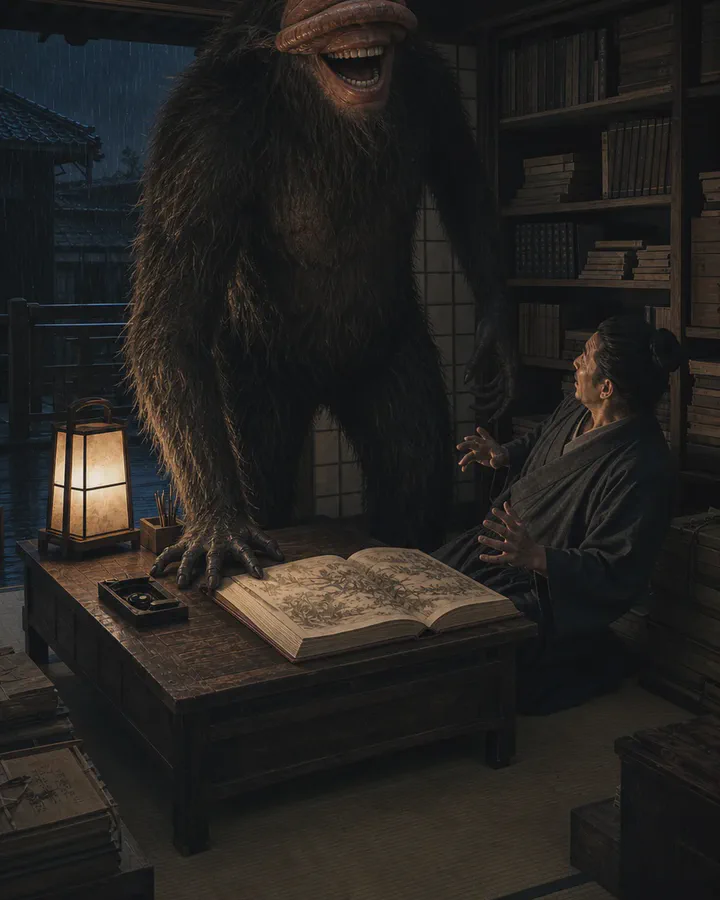
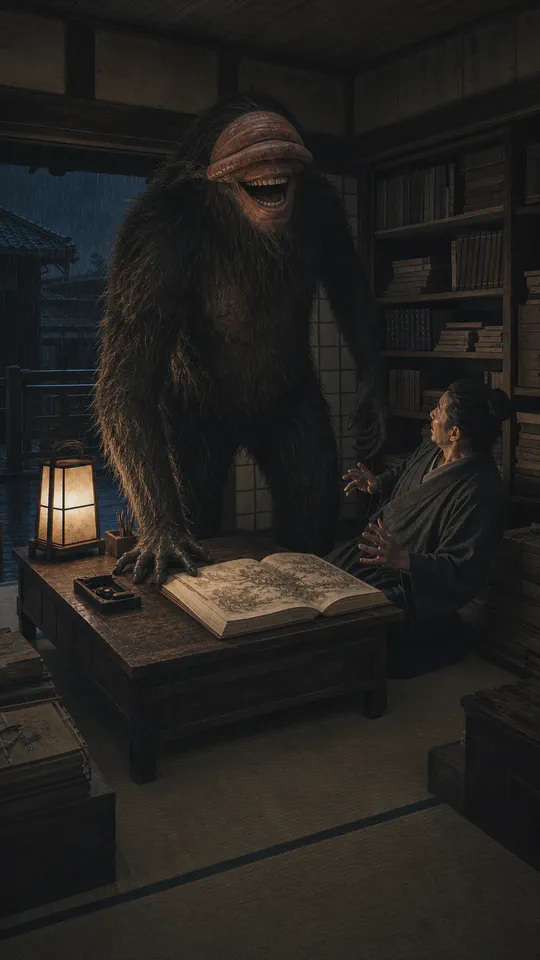
The hihi entry belongs to that reference apparatus. Assembled from older Chinese descriptions, it gives a creature that is human in shape, covered in black hair, long-lipped, and immensely strong. It runs fast. It makes sounds resembling human speech. And when it sees a person, it laughs — at which point its upper lip rolls up and covers its own eyes.
That last detail is the entire creature. Whatever else it can do, the sight of you shuts it down.
Appearance
Our illustration follows the entry: a huge, human-shaped animal, long black hair over most of the body, a broad reddish face, long arms, small eyes, and an upper lip so long that it has somewhere to go when the creature laughs. The moment shown is the laugh itself — the lip pushed up across the eyes, the mouth open, the face suddenly useless for seeing.
The setting is a study on a rainy night, because that is where a Japanese reader would have met this animal. The encyclopedia is on the desk.
Behavior and abilities
- It laughs. Not at a joke, not at a person’s expense. It laughs on sight, the way a reflex fires.
- It goes blind doing it. The lip covers the eyes for as long as the laughing lasts.
- It is strong and fast. Both are stated plainly and neither is demonstrated on anyone.
- It sounds like a person. The entry describes a voice resembling human speech, which is worse than a roar and harder to place in the dark.
Where the encyclopedia put it
The entry does not locate the hihi anywhere near its readers. It follows the Chinese material it quotes and places the creature in mountains to the southwest — foreign geography, at the far end of a long chain of texts.
This matters more than it sounds. A Japanese reader in 1712 could not walk out and check. No village had a hihi story to compare against, no family claimed a sighting, and no shrine kept a relic. The creature came pre-packaged, complete with a picture, at a distance no traveler was going to close.
Which means the hihi’s real habitat was the book. Japan’s monster population did not grow only out of things people said they saw on the road home. Some of it was imported, translated, illustrated, and shelved — and the hihi is what that process looks like when you catch it in the act.
Weaknesses and countermeasures
None are recorded. The entry supplies no charm, no ritual, no weapon, no prayer — nothing anyone was expected to do.
The only vulnerability in the whole description belongs to the creature itself, and it is not a defense so much as a design flaw: a face that stops working at the exact moment it has found someone to look at. Whether those few seconds were good for anything, the encyclopedia does not say. It was never that kind of book.
The encyclopedia entry and later imagery
Documented entry. A human-shaped, black-haired, long-lipped creature of great strength and speed, with a voice like human speech, living in the southwestern mountains of the Chinese sources the encyclopedia quotes. On seeing a person it laughs, and its upper lip rolls up over its eyes. No attack, no victim, no remedy.
Later imagery. Over time the name drifted toward something simpler and larger: a giant ape, sometimes a mountain monster demanding tribute, sometimes nothing more exotic than the modern Japanese word for a baboon. Later storytellers gave it appetites, and later illustrators gave it fangs. Both improvements cost it the thing that made the 1712 entry stay with you — a creature that finds you, finds you funny, and is left standing there with its own face in the way.
Sources and further reading
- Primary text Wakan Sansai Zue (和漢三才図会), c. 1712 (external link) Center for Open Data in the Humanities Digitized copy of Terajima Ryōan's illustrated encyclopedia. The hihi entry compiles older Chinese descriptions: human-shaped, black-haired, long-lipped, strong, fast, and laughing with its upper lip over its eyes.
- Library Wakan Sansai Zue (倭漢三才図会) bibliographic record (external link) National Diet Library Search Catalogue record establishing the work, its compiler, and its dating.
- Museum Hihi illustration from Wakan Sansai Zue (external link) Wikimedia Commons The woodblock illustration accompanying the encyclopedia entry.
- Database Classical usages of 狒 (feifei) (external link) Chinese Text Project Occurrences of the character in classical Chinese texts, the tradition the encyclopedia entry draws on.
Related yokai
Nue
鵺(ぬえ)
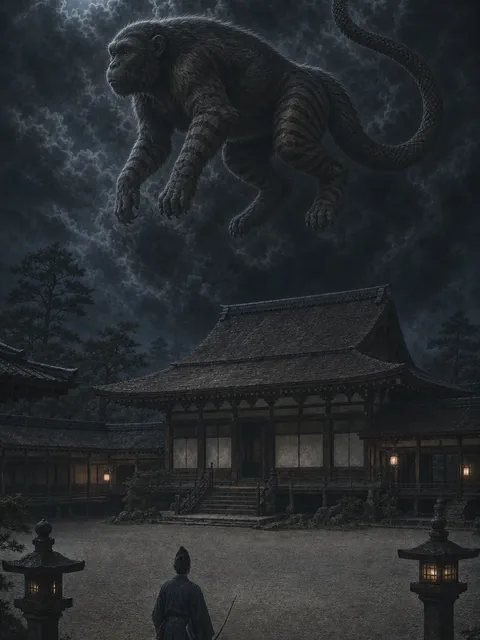
In The Tale of the Heike, a black cloud and a bird's cry sicken the emperor until an archer shoots the creature down — and the versions disagree on what fell.

Raijū
雷獣(らいじゅう)
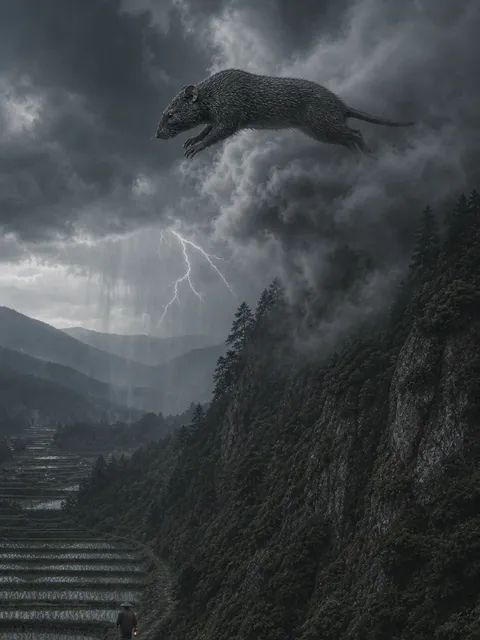
An Edo-period account from Shimotsuke describes a mouse-like animal that waited in a mountain hole each summer until its own thundercloud came to collect it.