Hakutaku: The Beast Whose Picture Was the Charm
白澤(はくたく) Hakutaku ASCII: Hakutaku
Also known as: 白沢, Baize
Pronunciation: hah-koo-TAH-koo
A beast from Chinese legend that named every harmful thing in the world for the Yellow Emperor, and whose image — nine eyes, six horns, a human face — was carried by Edo travelers and set beside pillows during the cholera epidemic of 1858.
Quick Facts
- Habitat
- House, Road
- Region
- China (origin), Japan, Ryukyu
- Recorded period
- known to Japanese scholars by the Heian period, images circulated as charms through the Edo period, cholera epidemic of 1858
- Nature
- Helpful
- Danger rating
The danger rating is an editorial summary made for readability. It is not an objective measure found in folklore sources.
Watch the Short
What is Hakutaku?
Most creatures in these files are things people were afraid of. Hakutaku is the opposite: a beast people wanted in the house.
It begins in China, where it is called Baize. The legend has it meeting the Yellow Emperor, understanding human speech, and doing something no other creature in this collection does — it names things. Every harmful being in the world, catalogued and handed over. The emperor is said to have had the list written down.
That story is the seed of everything that follows. If a beast once told a ruler the names of all the dangerous things, then a picture of that beast is a picture of someone who knows what is out there. Japanese scholars knew of the hakutaku by the Heian period. By the Edo period, its image was something an ordinary person could own.
Appearance
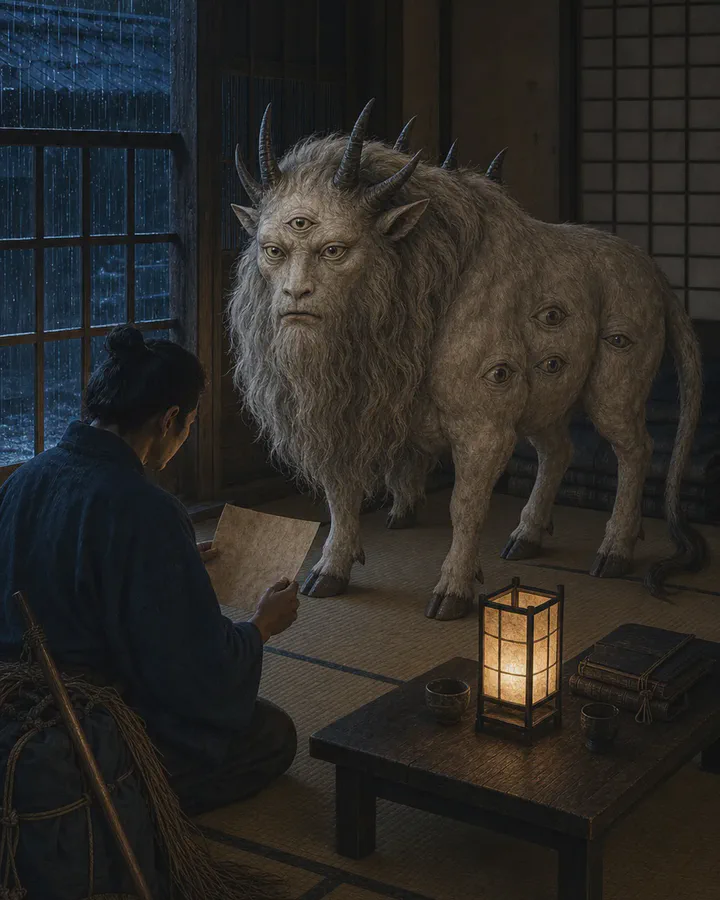
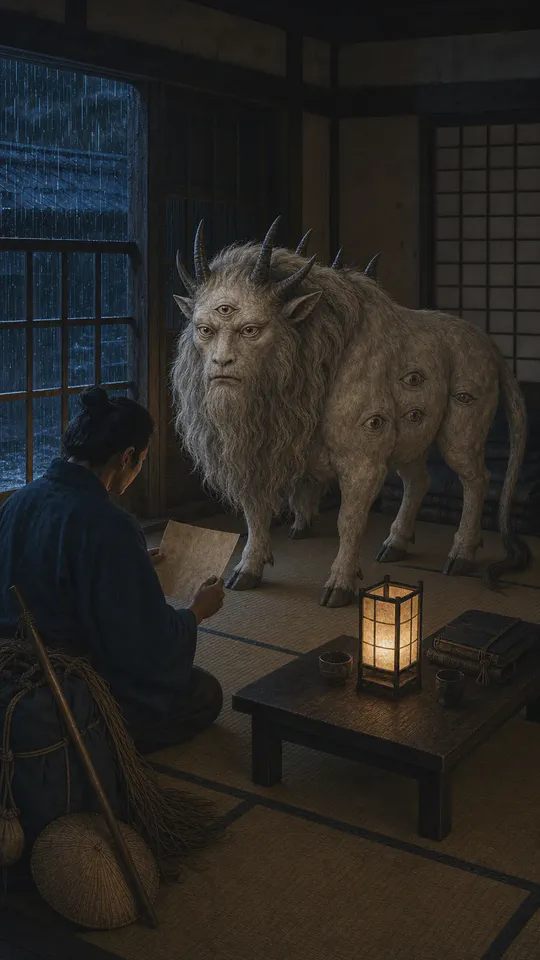
The version shown here is one Japanese type that circulated in the late Edo period: a human face on a four-legged body, three eyes across the brow and three more down each flank for nine in total, and six horns rising from the head and back.
It is a body built for the job. Eyes on every side of an animal that is supposed to have missed nothing.
Elsewhere the picture changes completely. Lion-bodied versions exist, and dragon-bodied ones, and forms recorded in China, Korea, Japan, and the Ryukyu Kingdom that share the name and little else. The pale coat in our illustration is a choice made for the screen rather than a fixed colour handed down from antiquity.
Behavior and role
- It knows. The tradition gives it knowledge of the world’s strange and harmful things, in detail and by name.
- It speaks. Human language is not a trick it performs. It is how the legend has the exchange happen.
- It warns. The transaction with the Yellow Emperor is information, not force.
- It never fights. No account here has it hunting, devouring other spirits, or being summoned against anything.
The picture as the charm
Here is the part that makes hakutaku unusual. The protection was not something the creature did for you. It was something you got by having the image.
Painted hanging scrolls survive under titles that say so plainly — hakutaku hikai zu, the picture of hakutaku warding off strangeness — including one held by the Iwate Prefectural Museum. Printed sheets were made for households; the British Museum holds an example. Travel manuals of the Edo period carried hakutaku images for people going out on the road, where illness and accident were harder to plan around.
Then, in 1858, cholera reached Japan. Printed hakutaku sheets were produced during the epidemic, and people were said to place them beside their pillows against sickness and bad dreams. That is what the record shows: not a treatment, but something to put next to your head at night in a year when a great many people were dying and nobody could say why.
Weaknesses and countermeasures
The question inverts here. A hakutaku has no recorded weakness because nothing in the tradition ever opposes it — there is no story in which someone needs to get past one.
What the sources do record is the reverse relationship: the conditions under which the creature works for you. Own the image. Carry it when you travel. Keep it where you sleep. The requirements are about the paper, not the beast.
Traditional tradition and later imagery
Documented tradition. A Chinese beast that understood speech and named the world’s harmful things for the Yellow Emperor; known to Japanese scholars from early on; by the late Edo period, an image with a human face, four legs, nine eyes, and six horns in one widespread type, though the surviving pictures from China, Korea, Japan, and Ryukyu differ from one another considerably. Carried by travelers, and printed and placed by pillows during the 1858 cholera epidemic.
Later imagery. Modern illustrated collections and games tend to settle hakutaku into a single fixed design — usually a white lion or ox with a readable number of eyes — and treat that as what a hakutaku is. The historical picture went the other way. It never held still, and it did not need to. The scroll on the wall and the sheet by the pillow were not portraits of an animal someone had seen. They were the protection itself, and a thing whose whole purpose is to be owned can afford to look like whatever the person drawing it believed.
Sources and further reading
- Museum Hanging scroll, Hakutaku hikai zu (白澤避怪図) (external link) Iwate Prefectural Museum A painted Hakutaku kept as a charm against misfortune, catalogued with the "warding off strangeness" title the images carried.
- Museum Hakutaku, the numinous beast — exhibition commentary (external link) Koga Historical Museum, Koga City Municipal museum account of the creature's Chinese origin, its meeting with the Yellow Emperor, and its use in Japan as a protective image.
- Museum Hakutaku no zu (白澤之図) (external link) Shurijo Castle Digital Museum A Ryukyuan version of the image, showing that the iconography travelled and changed outside the Japanese mainland.
- Museum Hakutaku hikai zu print (external link) British Museum A printed sheet of the charm, of the kind produced for household use.
- Academic paper Current state and problems in Hakutaku research (external link) Kansai University Academic Repository Survey of the scholarship, covering the transmission from China and the divergence of the surviving images.
Related yokai
Hihi
狒々(ひひ)
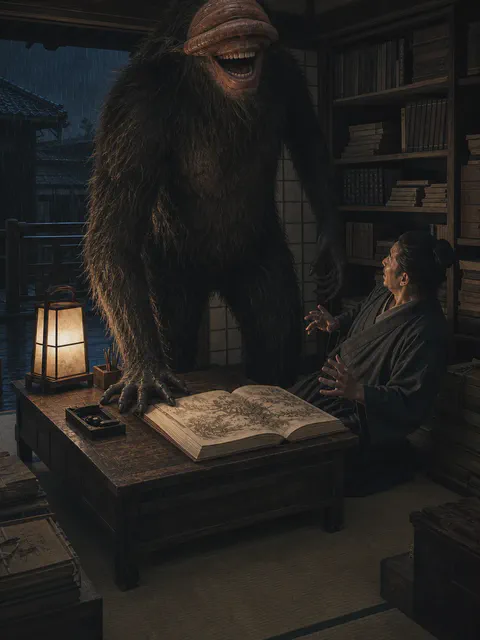
A 1712 Japanese encyclopedia compiled older Chinese descriptions of a black-haired, long-lipped creature that laughs when it sees a person — and whose upper lip then rolls up over its own eyes.
Nue
鵺(ぬえ)
In The Tale of the Heike, a black cloud and a bird's cry sicken the emperor until an archer shoots the creature down — and the versions disagree on what fell.