
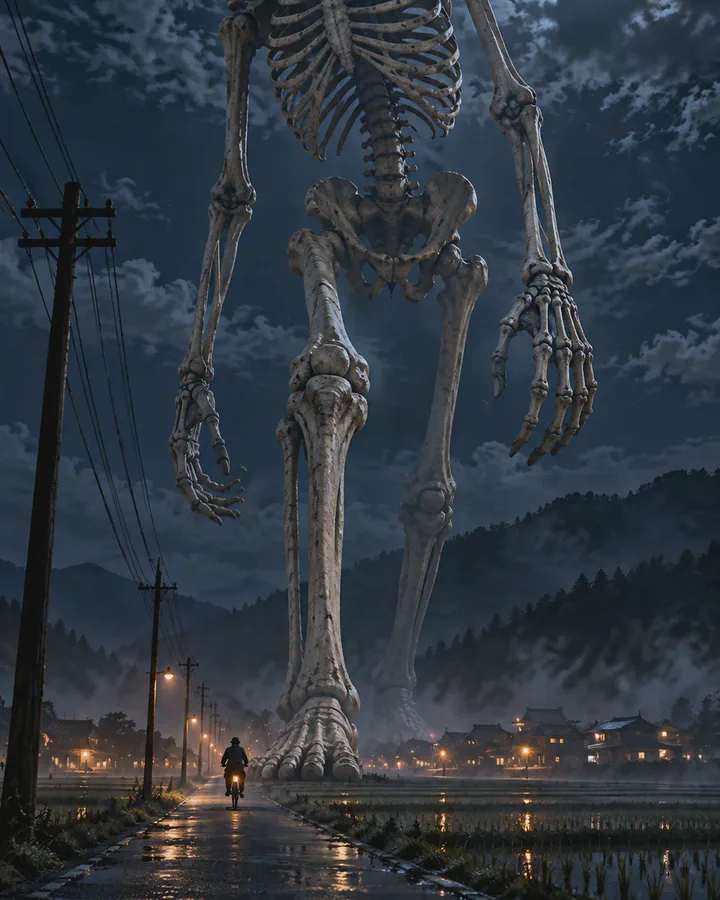
Gashadokuro: The Famous Yokai Younger Than Television
がしゃどくろ Gashadokuro ASCII: Gashadokuro
Pronunciation: gah-shah-DOH-koo-roh
Gashadokuro, the giant skeleton, looks ancient. It was created by the writer Saitō Morihiro in 1966, taken into Mizuki Shigeru's yokai collection in 1968, and later matched to a Kuniyoshi print from the 1840s that never used the name.
Quick Facts
- Habitat
- Field, Road
- Region
- unspecified
- Recorded period
- 1966 magazine feature, 1968 yokai books
- Nature
- Harmful
- Danger rating
The danger rating is an editorial summary made for readability. It is not an objective measure found in folklore sources.
Watch the Short
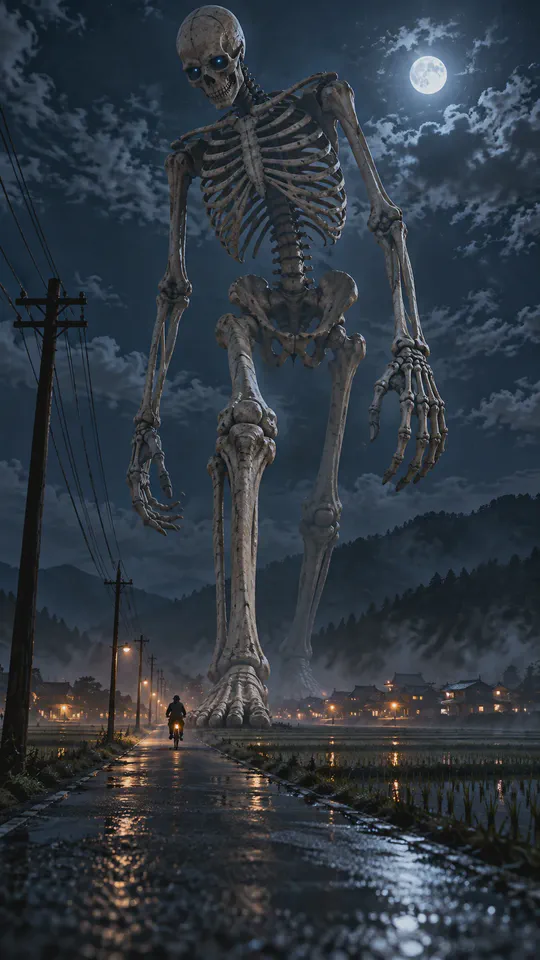
What is Gashadokuro?
Dokuro is a skull. Gasha is a rattling, clattering sound — the noise of bones knocking together. Gashadokuro is the giant skeleton that roams the fields at night, assembled, so the story goes, from the bones of the unburied dead.
It is one of the most recognisable yokai in the world. It is also one of the youngest.
Where it came from
There is no historical record of gashadokuro before the late 1960s.
The folklorist Hirota Ryūhei traces it to the writer Saitō Morihiro, who created it in 1966 for a magazine feature on yokai — part of a wave of popular “strange and mysterious” writing that filled children’s and girls’ magazines in the period. Saitō and writers like him cared little whether each creature had an old source.
In 1968, gashadokuro was taken into Mizuki Shigeru’s illustrated collection of yokai and presented as an authentic one. That was the year of the great yokai boom: Mizuki’s GeGeGe no Kitarō reached television, and yokai films and illustrated encyclopaedias poured out for children. A creature included in those books looked as old as any other.
The picture it borrowed
The image most people associate with gashadokuro is older. Around 1845–46, Utagawa Kuniyoshi made a famous triptych, Sōma no Furudairi — “The Old Palace at Sōma.” In it, the sorceress Takiyasha-hime summons an immense skeleton that leans out of the ruined palace over the warrior who has come to confront her.
That skeleton is not called gashadokuro. It belongs to a different story, about a rebel’s daughter and her sorcery, and it has no name in the print. The art historian Ichikawa Hiroya notes that the giant skeleton of Kuniyoshi’s print was among the old images that were given new yokai names in the 1960s books.
So the creature and the picture met a hundred and twenty years after the picture was made.
Appearance
A skeleton many times taller than a person, walking at night. Our illustration puts it where it was born: not an Edo-period ruin but a modern road, with telephone poles, power lines, and a single person walking home underneath.
Behavior and abilities
The 1960s descriptions give it a habit and a purpose: it wanders at night, its bones rattling, and it seizes travellers. Those details come from the same modern writing that created it, and they vary among the books that repeated them.
Weaknesses and countermeasures
No traditional remedy exists, because no tradition does. The creature is too young to have one.
Modern origin and the older image
Documented origin. Created by Saitō Morihiro in 1966; included in Mizuki Shigeru’s yokai collection in 1968 during the yokai boom; no record before the late 1960s. Later paired with the giant skeleton in Utagawa Kuniyoshi’s Sōma no Furudairi triptych of around 1845–46, which shows a different story and does not use the name.
Later imagery. Gashadokuro now appears in games, anime, and yokai encyclopaedias around the world, often described as an old legend of famine and war dead, and nearly always illustrated with Kuniyoshi’s skeleton.
That is the most interesting thing about it. A yokai written in 1966 borrowed a picture from 1845, and the picture made everyone believe the yokai was old.
Sources and further reading
- Academic paper Traversing the Natural, Supernatural, and Paranormal: Yōkai in Postwar Japan (external link) Hirota Ryūhei; Japanese Journal of Religious Studies 48/2 (2021) Gashadokuro was fabricated by Saitō Morihiro in 1966 and taken into Mizuki's 1968 collection, with no historical record before the late sixties.
- Academic paper The Contemporary Use of the Re-Creation of Yokai (external link) Ichikawa Hiroya; Bijutsu Kyōikugaku Kenkyū 50 (2018) Notes that the giant skeleton in Kuniyoshi's Sōma no Furudairi was given the name gashadokuro in the 1960s yokai books.
- Museum Utagawa Kuniyoshi, Sōma no Furudairi (The Old Palace at Sōma), triptych (external link) The British Museum Triptych of about 1845–46; Takiyasha summons a skeleton at the old Sōma palace.
Related yokai
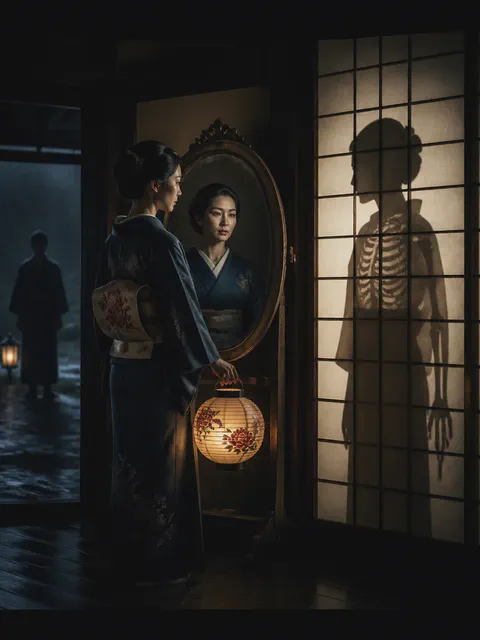
Hone-onna
骨女(ほねおんな)
Sekien drew Hone-onna in 1779 as an old skeleton carrying a peony lantern, and his caption names the 1666 tale behind it: a widower's night visitor whom only an outsider saw for what she was.
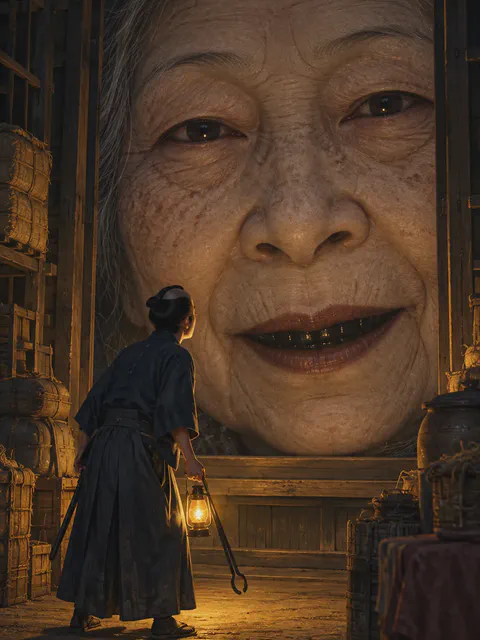
Ōkubi
大首(おおくび)
In the Inō Mononoke-roku, set in Miyoshi in 1749, sixteen-year-old Heitarō faces a month of nightly visitations. One night an old woman's face, teeth blackened, fills his doorway. He takes the fire tongs to it.