Funayūrei: The Ghost Crew That Asks for a Ladle
船幽霊(ふなゆうれい) Funayūrei ASCII: Funayurei
Also known as: 舟幽霊
Pronunciation: foo-nah-YOO-ray
A ruined boat draws alongside at night and its crew asks for a scoop. Give them an ordinary one, and they may use it to fill your boat with seawater.
Quick Facts
- Habitat
- Sea, Coast, Ship
- Region
- Ehime, Kōchi, Chiba, Fukuoka
- Recorded period
- modern folklore collections
- Nature
- Harmful
- Danger rating
The danger rating is an editorial summary made for readability. It is not an objective measure found in folklore sources.
Watch the Short
What are Funayūrei?
Funayūrei joins funa or fune, “boat,” with yūrei, “ghost.” The name covers a family of maritime traditions rather than one creature with a single appearance and origin.
The account featured here was published in a 1985 folklore journal and is catalogued for Ōzu and Uwajima in Ehime Prefecture. At night, a damaged boat approaches. Its boatmen call out for a shaku — a scoop or ladle. If the crew of the living boat hands over an ordinary one, the strangers use it to pour seawater into their boat.
The defense is practical and strange: knock out the bottom of the scoop before passing it across. The water then drains through instead of filling the boat.
Appearance
The Ehime record describes a ruined boat and boatmen, but it does not give the boatmen a fixed ghostly body. It does not say that they are skeletons, rotting corpses, pirates, or glowing figures.
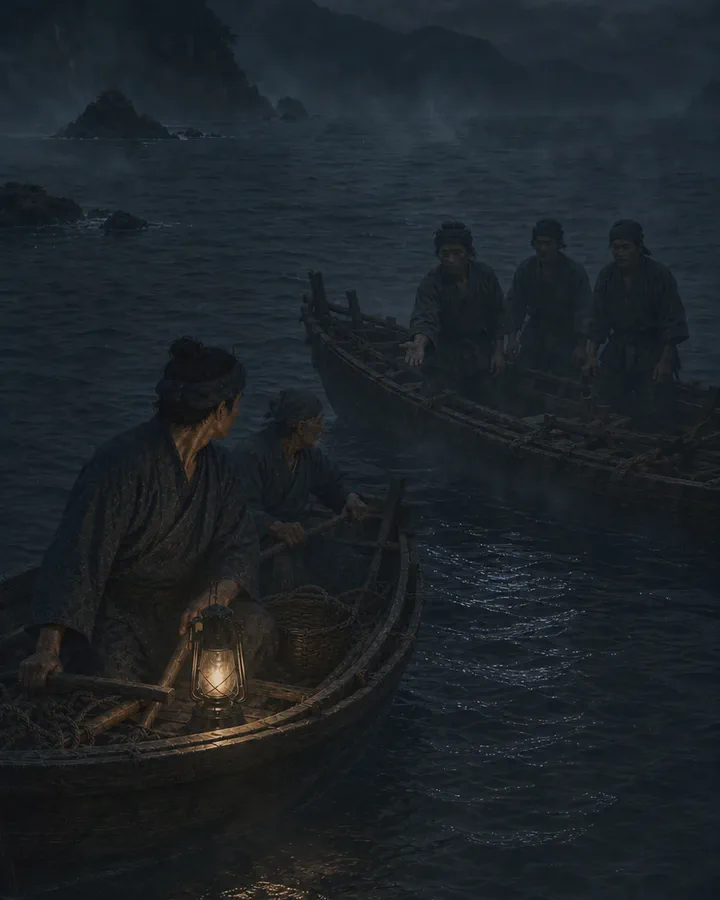
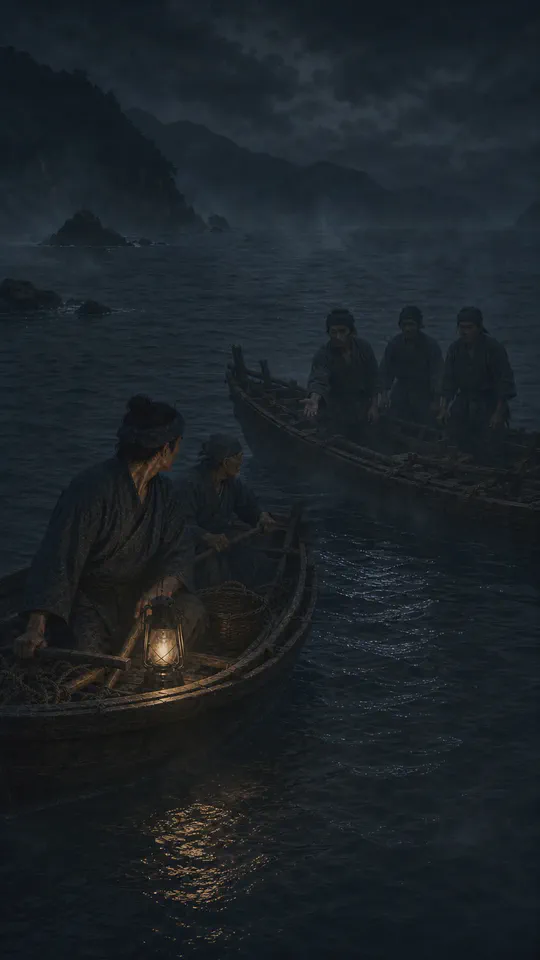
Our illustration stays close to the maritime setting: a small traditional Japanese wooden fishing boat sits unnaturally low in calm black water. Three adult boatmen wear wet gray-blue work clothes, while fog and shadow conceal most of their faces. The damage is visible in split planks and a broken gunwale, not in the bodies of the crew.
This is not the Western image of a towering ghost ship under full sail. The danger comes from how ordinary the encounter first appears — another work boat close enough for someone to reach across the gap.
Behavior and abilities
The adopted account gives the funayūrei a clear sequence of actions:
- They approach at night. A damaged boat comes alongside the living crew’s vessel.
- They ask for a scoop. The boatmen repeatedly demand a ladle used for moving water.
- They turn help into danger. If given an ordinary scoop, they use it to pour seawater into the other boat.
- They can be frustrated by a hole. A scoop with its bottom knocked out cannot hold the water needed to sink the vessel.
The record does not explain whether the boatmen are the spirits of drowned sailors, how their own boat moves, or what becomes of them afterward. Later retellings answer all of that, each in its own way, and no two agree.
Folklore accounts and regional variations
The bottomless-ladle defense appears in more than one coastal tradition. A 1931 record from Hata District in Kōchi similarly warns that the boat will be filled with seawater unless the bottom of the ladle is knocked out. Collected examples from Chiba and Fukuoka preserve related encounters and use terms such as shaku or akatori for the object handed over.
The details are not identical. Some traditions concern a boat or crew; others emphasize voices, lights, a mass of apparitions, or the dangerous date and location of the encounter. Even the requested tool changes with local boat practice. Funayūrei is therefore best treated as a broad maritime category whose stories share motifs, not as one standardized ghost crew operating everywhere in Japan.
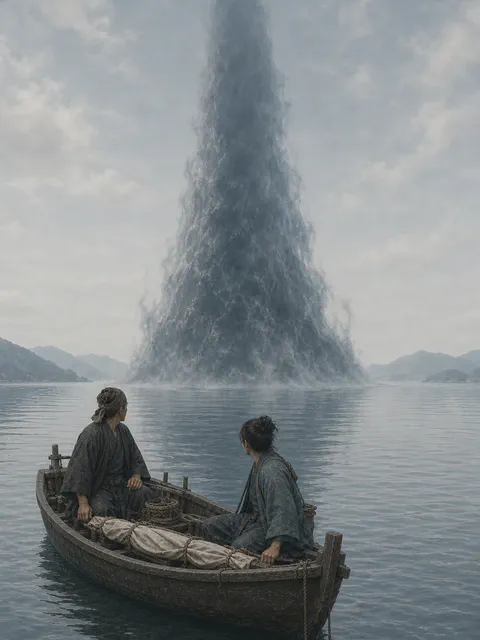
It should also be kept separate from Umi-bōzu. Both can threaten people at sea, but an Umi-bōzu account may describe a vast, shapeless figure rising from calm water, while the story here centers on a damaged boat, humanlike boatmen, and a requested scoop.
Weaknesses and countermeasures
The countermeasure is built into the story: give the boatmen a scoop whose bottom has been removed.
It is not a magical weapon. Its usefulness comes from the simplest piece of physical logic — water cannot remain in a container with a large hole. The tradition turns practical knowledge of a boat’s tools into protection against a supernatural encounter.
The defense only works where the encounter takes this shape. It belongs to accounts that specifically involve a requested ladle, scoop, or akatori — where the trick depends on the object being handed over.
Traditional folklore and later imagery
Documented tradition. The adopted Ehime account describes a damaged boat approaching at night, boatmen asking for a scoop, and the danger of having seawater poured into the living crew’s vessel. A bottomless scoop prevents it. Related coastal records preserve variations of the same motif.
Later imagery. Modern horror often combines all Japanese sea apparitions into one spectacle: a giant Western-style ghost ship crewed by drowned skeletons, surrounded by blue fire and sea monsters. That image borrows freely from several traditions. The recorded encounter is smaller and more immediate — two wooden boats in the dark, a hand extended across the water, and one ordinary tool that must be prepared correctly.
Sources and further reading
- Fieldwork collection Funayūrei account from Ehime, record 0200237 (external link) International Research Center for Japanese Studies The adopted account: a damaged boat approaches at night, boatmen ask for a scoop, and the safe response is to knock out its bottom before handing it over.
- Fieldwork collection Funayūrei account from Kōchi, record 2260176 (external link) International Research Center for Japanese Studies A regional example in which an ordinary ladle allows the boat to be filled with seawater.
- Fieldwork collection Funayūrei account from Chiba, record 1230149 (external link) International Research Center for Japanese Studies A Chiba example useful for comparing the scoop motif across coastal traditions.
- Fieldwork collection Funayūrei account from Fukuoka, record C4020007-000 (external link) International Research Center for Japanese Studies A Fukuoka example showing regional variation in maritime ghost encounters.
- Academic paper A Comparative Study of Funayūrei from the Perspective of Maritime Folklore (external link) National Diet Library Search Academic comparative discussion of funayūrei traditions.