Dorotabō (泥田坊): The Field That Wants to Be Given Back
The one-eyed black figure of Sekien's 1781 picture book, shouting for a rice field that a drinking son sold, and the two centuries of readers who have tried to say what it is
泥田坊(どろたぼう) Dorotabō ASCII: Dorotabo
Pronunciation: doh-roh-tah-boh
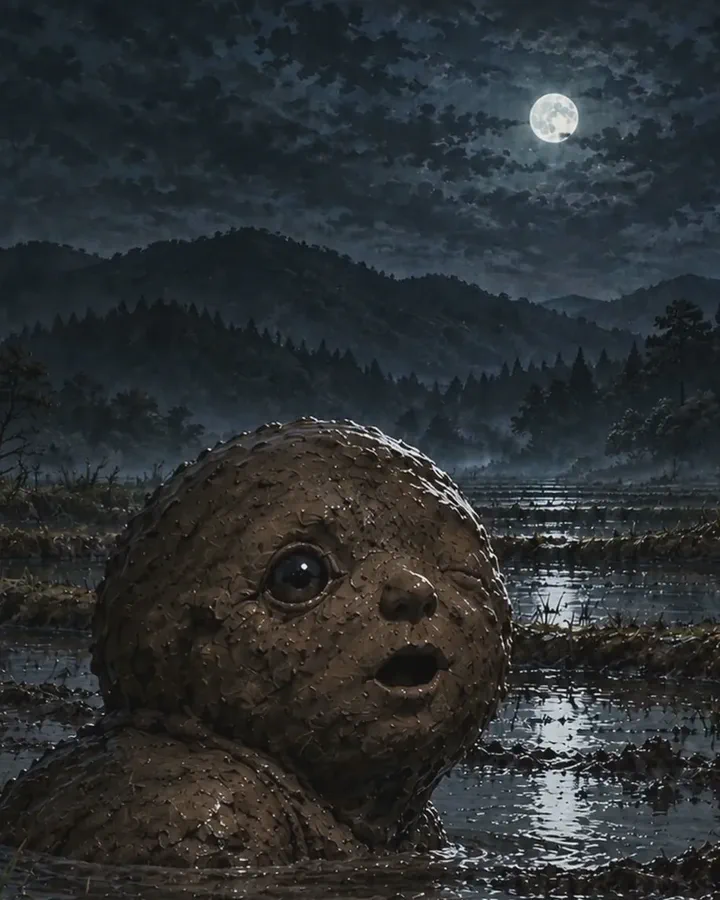
Dorotabō (泥田坊) is the one-eyed figure that rises to the waist out of a rice paddy in Toriyama Sekien’s picture book of 1781. The caption beside it tells of an old man of the northern provinces who bought a little land for his descendants and worked it in every weather; after he died his son took to drink and sold it, and night after night a black thing with one eye came out shouting “Give back the field!” No older book and no village record knows the name. The ghost of the old farmer, the guardian of the paddies and the monster woken by bulldozers were all added in the twentieth century.
Quick Facts
- Habitat
- Field
- Region
- Japan
- Recorded period
- Konjaku Hyakki Shūi (1781; reprinted 1805), twentieth-century yokai books, films and cartoons (1968 onward)
- Nature
- Unknown
- Danger rating
The danger rating is an editorial summary made for readability. It is not an objective measure found in folklore sources.
Watch the Short
Who is Dorotabō?
In 1781 the Edo painter Toriyama Sekien published the third of his picture books of monsters, three volumes named Cloud, Mist and Rain. The tenth picture of the Cloud volume shows a figure up to its waist in a rice paddy, with a single eye in its face and three fingers on each hand. The caption beside it is a few lines long. Long ago, it says, there was an old man in the northern provinces who bought a little land for the sake of his descendants, and who never neglected the work of the season in cold or heat, wind or rain. After the old man died, his son gave himself up to drink and did no farming, and in the end sold the field to someone else. Then, night after night, a black thing with one eye came out and shouted “Give back the field! Give back the field!” This, the caption ends, is what is called the dorotabō.
That is the whole of it. The province has no name, nor the old man, nor the son, nor the buyer. Nobody is hurt, nothing is done about the voice, and the story does not end; it simply stops with the thing in the mud, still shouting. No book older than Sekien’s has a dorotabō in it, and none of the village traditions collected since has one that does not go back to his page.
What does dorotabō mean?
The name is written 泥田坊. Doro-ta (泥田) is a muddy rice field, and bō (坊) is the character for a monk’s quarters and so for a monk, and for a boy: “the monk of the mud field”.
The name may also be a joke with three or four layers. One reading derives it from a proverb, doro-ta o bō de utsu, “to beat a mud field with a stick”, said of doing something senseless and making a ruin of everything, which is a fair account of the son. Another points to a man: Shinagawa Genko, a physician to the Kishū domain, wrote comic kyōka verse under the pen name Dorotabō Yumenari, may have known Sekien through the verse circles, and is said to have ruined himself in the Yoshiwara.
The Yoshiwara reading
The fullest of the modern readings takes the whole page for a satire. Hokkoku, “the northern provinces”, was also an Edo nickname for the licensed quarter of Shin-Yoshiwara, which lay north of the castle as Shinagawa lay south; a comic book of 1776 already calls the quarter “the north”. The land around it was known as the Yoshiwara paddies. On this reading the field in the north is the brothel district, doro, mud, plays on a word for dissipation written with a different character, the dead old man is a pun on a pledge forfeited at the pawnshop, and the cry of “give back the field” is a piece of the quarter’s own slang. The black thing in the mud is then no farmer at all but a portrait of what swallows a family’s land: a son’s nights in the Yoshiwara.
Nothing on the page says so, and nothing on the page forbids it. The same book builds the caption of another of its monsters, the many-eyed mokumokuren, on a pun about the “eyes” of a Go board, and a comic poet’s pen name, a nickname for the brothel quarter and a tale of a squandered inheritance sit together on this one sheet. What the reading leaves in place is the picture, which is of a paddy, and of something standing in it and shouting.
Appearance
The print gives three things: one eye, three fingers on each hand, and a body that is visible only from the waist up, the rest being under the mud. The caption adds one more: it is black.
The three fingers have been read as closely as the name. A book of 1981 proposed that the five fingers of a human hand stand for two virtues, wisdom and compassion, and three vices, anger, greed and folly, so that a creature with three fingers has the vices and nothing to check them. That is a reading two hundred years younger than the print, which draws the hands and explains nothing about them.
Our illustration keeps the print’s three facts and the caption’s one: a dark figure of wet mud, one eye, a three-fingered hand lifted, waist-deep in a flooded field at night. The field, the ridges between the paddies and the light on the water are an imagined scene, placed in no particular province.
Behavior and abilities
- It comes out at night. Every night, the caption says.
- It shouts. Two words, repeated: ta kaese, “give back the field”.
- It appears after the sale. Not when the old man dies, and not while the son is merely idle, but once the land has gone to a stranger.
The caption never names the black thing. That it is the old man himself, turned by resentment into a monster after death, is how yokai books of the later twentieth century retold it; the 1781 text sets the death, the sale and the apparition one after another and leaves the reader to join them.
Weaknesses and countermeasures
None are given. The cry names its own remedy, and the caption ends with the shouting still going on: the son has sold, a stranger holds the land, and the voice comes back every night. There is no charm, no priest and no morning after. In a television cartoon of 1971 the creature draws its strength from water, re-forms as long as it is wet and weakens when it is dried out. That rule belongs to the cartoon.
Documented tradition and later imagery
Documented tradition. One page: the tenth picture of the Cloud volume of Sekien’s picture book of 1781, between the lamp-stand demon and the old woman of the temple kitchen, reprinted at Tsu in Ise in 1805. One eye, three fingers, half a body, and a caption about an old man, a son, a sale and a voice.
Later imagery. In 1974 a book of ghost stories from the north-east moved the creature to the Shōnai plain of Yamagata, where a mud-covered monk rises from a paddy to scold a neglected wife who has taken a snake for a lover, and tells her to plant rice instead; the tale has no source earlier than the book. Yokai encyclopaedias made the black thing the old farmer’s ghost. A monster film of 1968 put a dorotabō among its crowd of spirits and had it shoulder a coffin by itself in the closing procession. The television cartoon of 1971 opened with it rising against the developers who had taken its paddy, saying nothing but “give back the field”, and later series made it the guardian spirit of the rice fields. The bronze on the yokai street in Sakaiminato files it under the Hokuriku region and gives the father an illness, the land a pleased new owner and the monster a first night. Each of these is kinder than the print, because each of them knows who is shouting and why. Sekien’s page has a field that has changed hands, a voice that will not accept it, and no one left in the story who is able to give the field back.
Sources and further reading
- Primary text Dorotabō in Hyakki Yagyō Shūi, volume [2], frame 12 (external link) National Diet Library Digital Collections Digitized 1805 printing; the right-hand page of frame 12 carries Sekien's picture and caption: the old man of the northern provinces who bought land for his descendants, the son who drank and sold it, and the black one-eyed thing that shouts for the field every night. The figure has one eye and three-fingered hands and rises from the paddy from the waist up. Consulted for research only; the illustration is an independent work.
- Library Hyakki Yagyō, 3 volumes with Shūi, 3 volumes, [2] (百鬼夜行 3巻拾遺3巻) (external link) National Diet Library Search Bibliographic record of the copy read: Toriyama Sekien (1712-1788), published by Naganoya Kankichi at Tsu in Ise, Bunka 2 (1805), bound with the supplement as six volumes; digitized 2011. The printing date, not the date of first publication.
- Museum Konjaku Hyakki Shūi, Cloud volume (external link) Kawasaki City Museum Archive Record of the Cloud volume, dated An'ei 10 (1781), by Toriyama Sekien; the description names the dorotabō among the yokai the book adds and notes that, unlike the 1776 book, each picture has an explanatory text.
- Museum Konjaku Hyakki Shūi (external link) Tokyo Museum Collection Museum record identifying Toriyama Sekien and dating the work to 1781.
- Primary text Mokumokuren in Hyakki Yagyō Shūi, lower volume, frame 6 (external link) National Diet Library Digital Collections Digitized 1805 printing containing Sekien's image and caption; the work was first published in 1781 and the caption makes a pun on the eyes of Go.
- Museum Dorotabō by Toriyama Sekien (File:SekienDorotabo.jpg) (external link) Wikimedia Commons Public scan of the page from a modern reprint, for comparing the composition. Consulted for research only; the primary text is the library copy.
- Database Dorotabō (泥田坊) (external link) Wikipedia (Japanese) Auxiliary pointer with printed references: the caption, the absence of any comparable tradition in other early texts, the later books that make the creature the old farmer's ghost (1990), the 1974 Shōnai tale and its standing as a modern composition, the 1981 virtues-and-vices reading of the three fingers, the proverb and kyōka-pen-name derivations (1999, 2007), and the Shin-Yoshiwara reading (2000).
- Database Konjaku Hyakki Shūi (今昔百鬼拾遺) (external link) Wikipedia (Japanese) Contents list of the 1781 book: three volumes named Cloud, Mist and Rain, third in Sekien's series; the dorotabō is the tenth entry of the Cloud volume, after the tōdaiki and before the kokuri-baba.
- Reliable secondary Kita (北), Nihon Kokugo Daijiten (external link) Shōgakukan, via Kotobank Dictionary entry: "the north" as a name for the Shin-Yoshiwara quarter north of Edo castle, set against Shinagawa in the south, with hokkoku and hokkaku as equivalents and a first citation from a kibyōshi of 1776.
- Database Yōkai Hyaku Monogatari (妖怪百物語) (external link) Wikipedia (Japanese) The Daiei Kyoto film released 20 March 1968: a dorotabō is among its yokai and carries a coffin alone in the closing procession. Consulted for the later image only.
- Database Characters of GeGeGe no Kitarō (ゲゲゲの鬼太郎の登場キャラクター) (external link) Wikipedia (Japanese) The dorotabō of the cartoon: first seen in episode 1 of the second television series, rising when development takes its paddy and saying only "give back the field"; powered by water and weakened by drying; a guardian of the rice fields in the fourth and fifth series. Consulted for the later image only.
- Reliable secondary Yokai that lurk close to home: the bronze statues of Mizuki Shigeru Road (external link) Mizuki Shigeru Museum, Sakaiminato Statue 120, uwan, placed in Aomori as a loud voice in front of an old house with no visible body; statue 131, abura-sumashi, placed in Amakusa with the grandmother's story and a rustling in the bushes. Consulted for the later image only.
Records behind this article
Related yokai
Mokumokuren
目目連(もくもくれん)
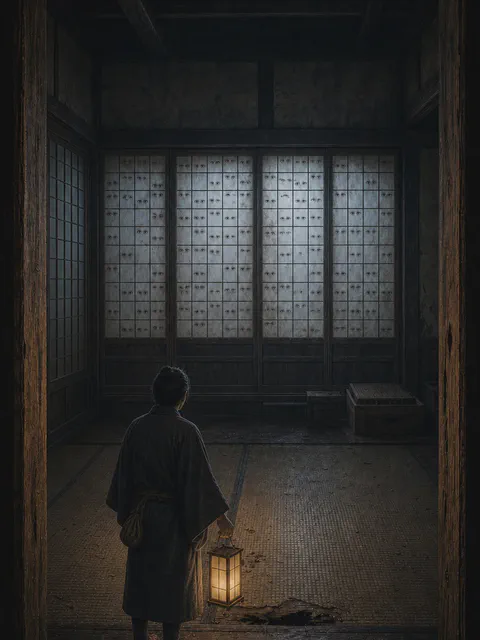
Rows of human eyes appear across old shoji in Toriyama Sekien's 1781 picture-book image.
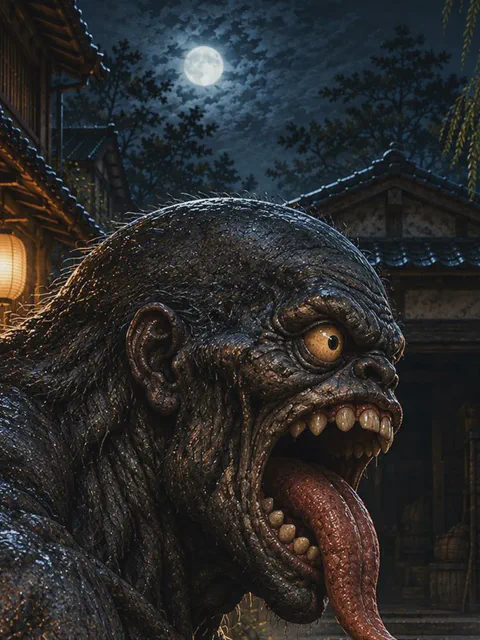
Uwan
うわん
The yokai that is only a picture: the black body, yellow eyes, open mouth and three-clawed hands of an undated scroll in Kyoto, the blackened teeth and raised hands of the 1737 scroll and Sekien's 1776 print, and the scream, the old mansion and the shout-back rule that were invented for it in 1972 and 1974.
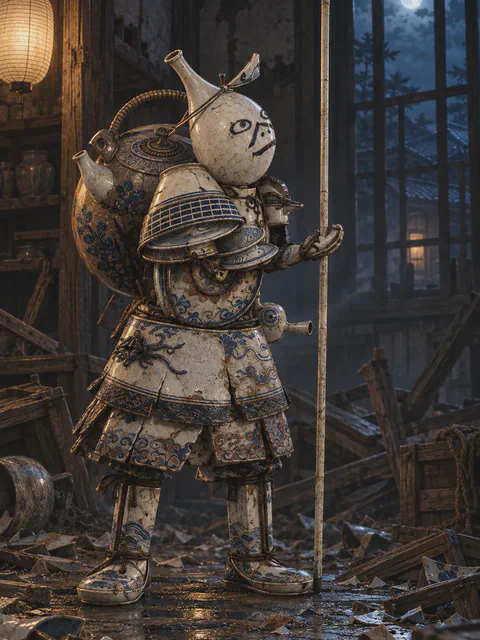

Seto-taishō
瀬戸大将(せとたいしょう)
Sekien's 1784 Seto-taishō is a warrior assembled from sake flasks, plates, bowls, a teapot, and a kettle, carrying a spear tipped with a vase. Its caption is a chain of puns on Cao Cao, Guan Yu, and the names of Japanese pottery.