
Chabukuro (茶袋): The Bag That Hangs Over the Road
A tea bag dangling in mid-air on an eerie stretch of road in Kōchi, written down in 1938, and the illness blamed on it
茶袋(ちゃぶくろ) Chabukuro ASCII: Chabukuro
Also known as: Chanbukuro
Pronunciation: chah-boo-koo-roh
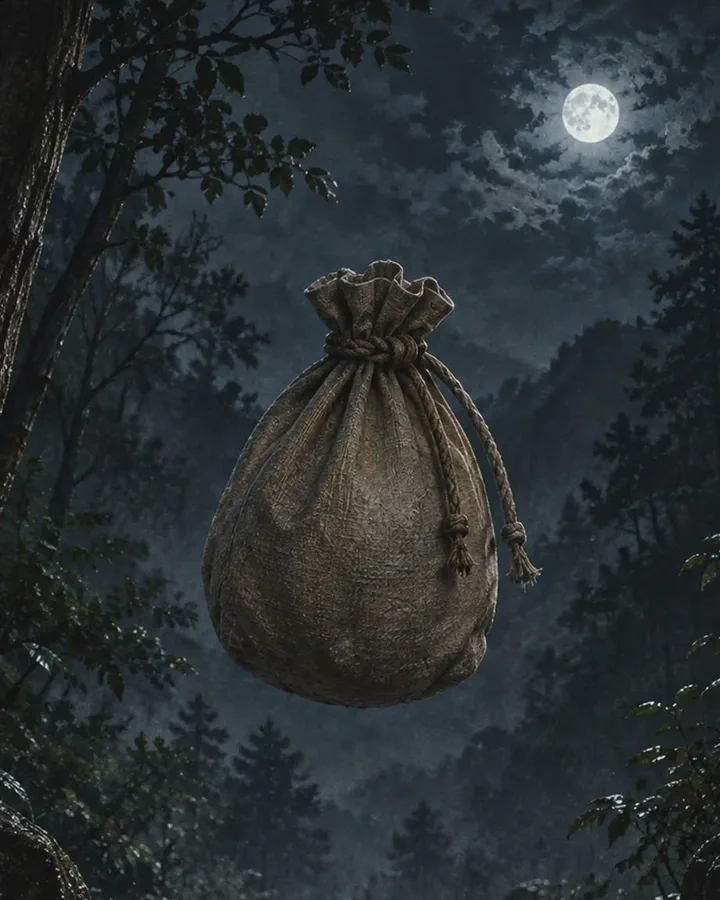
Chabukuro (茶袋, “tea bag”) is a thing shaped like a cloth bag for steeping tea that hangs down in mid-air on the eerie parts of a road. In Okuuchi village in the Hata district of Kōchi, a record of 1938 says it hangs at the uncanny places along the way, and that anyone struck by it falls ill with one sickness or another. Nobody describes its size, its colour, or who holds the string. A bag of the same name hung from a temple tree in Kagawa in 1933 and bobbed along rivers in Wakayama, and a kettle does the same work in Nagano.
Quick Facts
- Habitat
- Road, River, Temple or shrine
- Region
- Japan, Kōchi (Hata district), Kagawa (Marugame), Wakayama (Hidaka district)
- Recorded period
- 1933 and 1938 folklore records, modern yokai encyclopaedias
- Nature
- Harmful
- Danger rating
The danger rating is an editorial summary made for readability. It is not an objective measure found in folklore sources.
Watch the Short
What is Chabukuro?
On the roads around Okuuchi, a village in the Hata district at the south-western tip of Kōchi, there were places that felt wrong, and at those places a bag hung down. It was called the chabukuro, the tea bag. A note printed in 1938 in a folklore journal gives the whole of what was said: the chabukuro hangs down where the road is eerie, and a person who is struck by it comes down with all kinds of illness.
That is the record: a place, a bag, and a sickness. The bag’s size, its cloth, its contents and whatever holds it up are no part of it, and neither is what “struck by it” means, whether the bag swings into you or simply passing under it is enough. It says where, and it says what people feared, and it stops.
What does chabukuro mean?
A chabukuro is an ordinary object: a small cloth bag in which tea leaves are steeped, or in which they are carried. Cha is tea and fukuro is a bag; the f softens to b in the compound. The name describes the shape of the thing seen hanging, and nothing more. In Wakayama the same thing is called the chanbukuro, with an extra syllable.
The village of Okuuchi was formed in 1889 from thirteen hamlets, became the town of Ōuchi in 1951, and in 1957 merged with its neighbour to form the present town of Ōtsuki. The road the bag hung over is somewhere in the western half of Ōtsuki.
Other bags, other things that hang
The Kōchi bag is not alone. In the hamlet of Takayama in Tosayama, now part of Kōchi city, a chabukuro hung at a grave that people called the old woman’s grave; what it did to anyone is not told.
In Marugame, in Kagawa, a note of 1933 records that a chabukuro came down at night from the pagoda tree at a temple called Shōgen-ji, and that there was talk of one at the pine by the meeting hall too. There the villagers knew who was responsible: it was the work of a fox.
Along the Inami river in the Hidaka district of Wakayama the chanbukuro does more than hang. It floats down rivers, and it flies. In one telling a bag bobs up and down beside an empty riverbank; cold drops fall on the back of a passer-by’s neck, and the bag sails off over the mountain. At Tsubakihara the children called the one that went up and down their river the Tsubakihara chabukuro.
In Nagano the thing that dangles from a tree at night is not a bag but a kettle, the yakan-zuru. Bag, kettle, something on a string with nobody at the other end: the shape of the fear is the same, and the objects are the most ordinary things a household owns.
Appearance
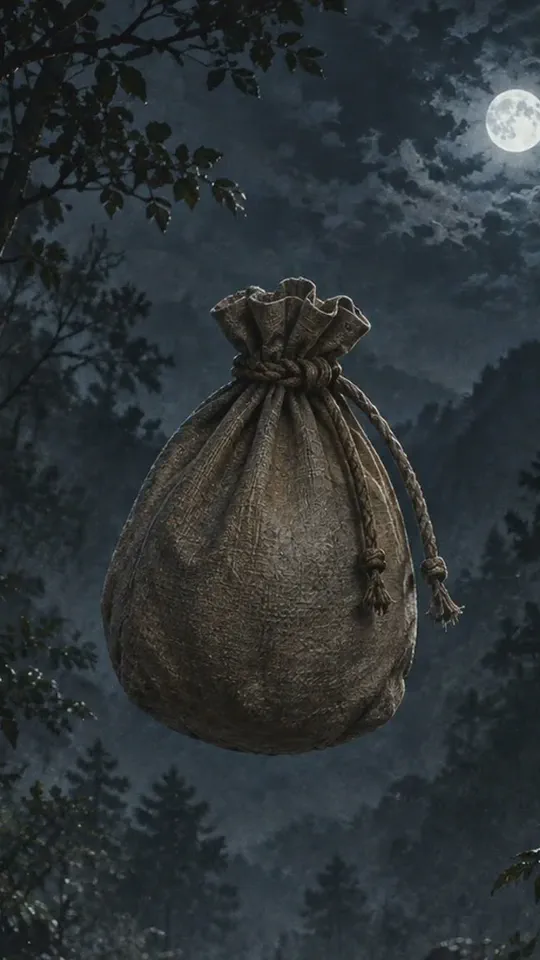
A cloth tea bag, hanging. The 1938 record gives nothing else, and the other accounts add only where it hangs and that it moves. Our illustration keeps to that: a bag of undyed cloth the colour of tea dust, tied with a short cord, in the air over a mountain road, with no branch or hand above it.
Behavior and abilities
- It hangs. On the eerie parts of a road in Kōchi, from a temple tree in Kagawa, at a grave in Tosayama.
- It brings illness. In Okuuchi, whoever is struck by it falls sick, with no one sickness named.
- In Wakayama it moves. It floats on rivers, drips cold water on your neck, and flies away over the mountain.
Nothing in the records has it speak, chase, or appear to a particular person. It is there, in the dark part of the road, and the harm comes afterward, at home, as a sickness with no other explanation.
Weaknesses and countermeasures
None are recorded. The Kōchi note offers no charm against it and no way to cure what it causes. The only advice implied by the record is the one the record takes for granted: know where the road is eerie, and do not linger under what hangs there. In Kagawa the bag was blamed on a fox, which at least gave it a culprit; in Kōchi it has none.
Documented tradition and later imagery
Documented tradition. A hanging tea bag on eerie roads at Okuuchi in the Hata district of Kōchi, with illness for anyone it strikes, printed in 1938; a chabukuro at a grave in Tosayama; a bag that came down from a temple tree in Marugame, Kagawa, in 1933, blamed on a fox; and the chanbukuro of the Inami river in Wakayama, which floats, drips, and flies.
Later imagery. The chabukuro is a small entry in the modern yokai encyclopaedias, usually grouped with the Nagano kettle among the things that hang in mid-air. In 2025 a television series about a ghost-fighting teacher gave it an episode of its own and a story that carries its characters into the past; the record from Kōchi knows nothing of journeys through time. It knows a road, a bag, and a sickness, and no hand at the other end of the string.
Sources and further reading
- Fieldwork collection Chabukuro, record 2180040 (external link) International Research Center for Japanese Studies Makita Shigeru, "Yōkai", Minkan Denshō 4(2), 1 November 1938, p. 9: at Okuuchi in the Hata district of Kōchi the chabukuro hangs where the road is eerie, and whoever is struck by it falls ill.
- Fieldwork collection Tanuki, record 0640451 (Marugame, Kagawa) (external link) International Research Center for Japanese Studies Kyōdo Kenkyū 7(2), 1933: a chabukuro comes down at night from the pagoda tree at Shōgen-ji in Marugame, said to be a fox's doing; talk of one at the meeting-hall pine.
- Database Chabukuro (茶袋 (妖怪)) (external link) Wikipedia (Japanese) The Ōtsuki identification, the grave at Takayama in Tosayama, and the Wakayama chanbukuro of the Inami river that floats, drips and flies.
- Database Yakan-zuru (薬缶吊る) (external link) Wikipedia (Japanese) The Nagano kettle that hangs from a tree at night, grouped with the Kōchi chabukuro among the things that hang in mid-air.
- Database Ōuchi, Kōchi (大内町 (高知県)) (external link) Wikipedia (Japanese) Okuuchi village formed in 1889, renamed Ōuchi in 1951, merged into Ōtsuki in 1957.
- Reliable secondary Hell Teacher Nūbē (2025), episode 15 (external link) Official site of the television series The episode that uses the chabukuro; consulted only to separate the series' journey into the past from the record.
Where it was recorded
- 1938
Okuuchi village, Hata district (now Ōtsuki), Kōchi
Folklore record
A tea bag hangs down where the road is eerie; whoever is struck by it falls ill
- undated
Takayama, Tosayama (now Kōchi city), Kōchi
Legend or tale
A chabukuro hung at a grave called the old woman's grave
- 1933
Shōgen-ji temple, Marugame, Kagawa
Folklore record
A chabukuro came down at night from the temple's pagoda tree; blamed on a fox
- undated
Inami river, Hidaka district, Wakayama
Legend or tale
The chanbukuro floats on rivers, drips cold water on a passer-by's neck and flies off over the mountain
Places named in the records behind this article. Coordinates are approximate. View on the map
Related yokai
Tenjō-sagari
天井下り(てんじょうさがり)
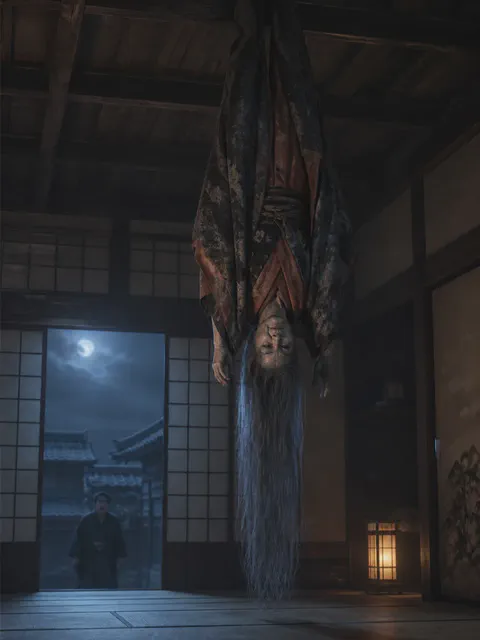
In 1779 Sekien drew an old woman hanging upside down from the ceiling, and wrote a caption that is mostly a joke — about a demon who once escaped through a roof, and a phrase for knocking someone flat.
Betobeto-san
べとべとさん(べとべとさん)
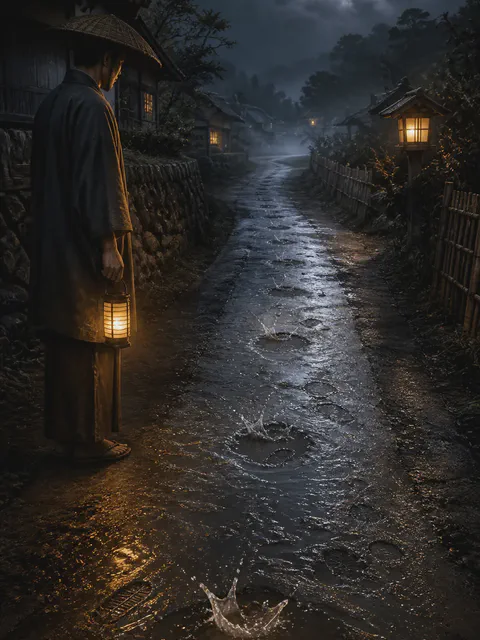
On a night road in Uda you hear a bita-bita footfall coming along behind you. There is nobody there. Step aside, say the words, and it stops — which is the entire record.
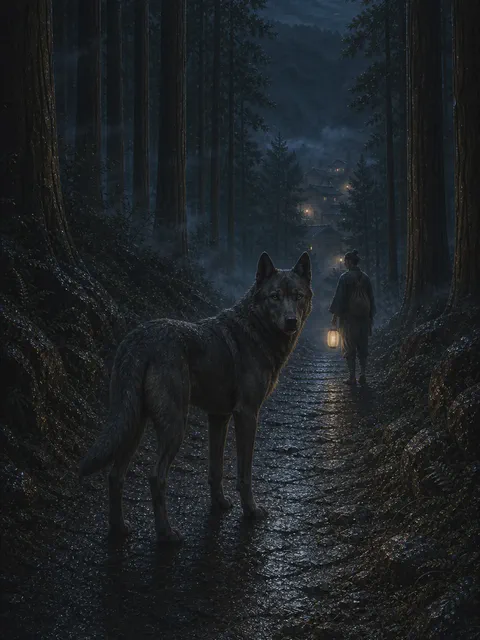
Okuri-inu
送り犬(おくりいぬ)
A 1936 Gifu account describes a mountain dog that follows a traveler all the way to his door — and leaves only after salt and a word of thanks.