Boroboroton: The Futon Yokai Made From a Pun
暮露暮露団(ぼろぼろとん) Boroboroton ASCII: Boroboroton
Pronunciation: boh-roh-boh-roh-TOHN
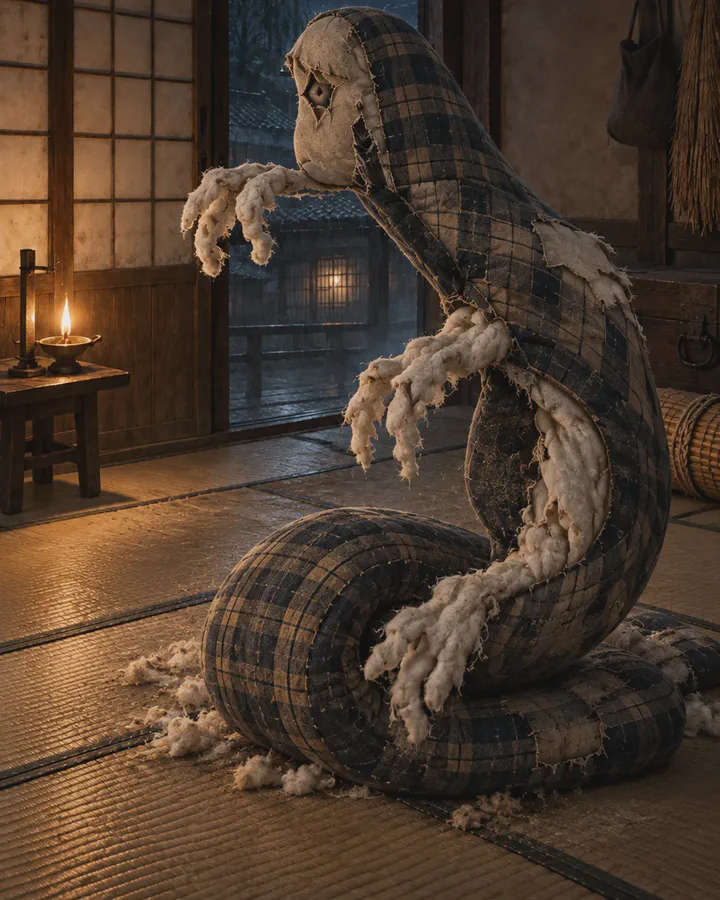
Sekien's 1784 Boroboroton is a worn, patched futon standing upright with cotton spilling out like hands. His caption gets there through wandering Zen mendicants, an old poetry contest, and one word that means both.
Quick Facts
- Habitat
- House
- Region
- unspecified
- Recorded period
- Toriyama Sekien's Hyakki Tsurezure Bukuro (1784)
- Nature
- Unknown
- Danger rating
The danger rating is an editorial summary made for readability. It is not an objective measure found in folklore sources.
Watch the Short
What is Boroboroton?
Boroboro means ragged, tattered, worn to pieces. A futon is bedding. Boroboroton — written by Sekien as 暮露暮露団 — is the ragged futon.
It appears in the middle volume of Hyakki Tsurezure Bukuro, Toriyama Sekien’s 1784 collection of household objects turned into yokai. Like most entries in that book, the creature is drawn from an object and named through a joke. Here the joke is the whole point.
The plate
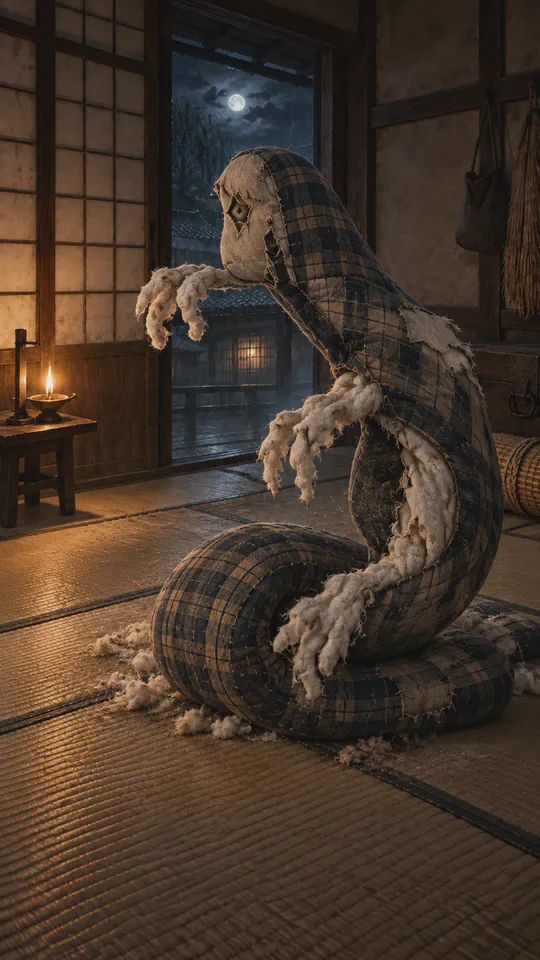
A thick futon with a checked pattern has stood up on end. Its lower half loops around on the floor, so the whole body curves like an S. It is torn in places, and the cotton wadding that spills out of the tears forms tufts that hang like hands. Stitch lines suggest eyebrows. The room around it is broken and disordered, as everything in this book is: Sekien frames the collection as creatures he met in a dream, in a ruined old palace.
It is not a monster wearing a futon. There is no head, no torso, no legs. The bedding itself is the creature.
The caption
Sekien’s text takes three steps.
First, the monks. The Fuke school of Zen, he says, are called komusō. Because they hold to emptiness and stillness and will sit anywhere on a straw mat, they are also called komosō — “straw-mat monks.” The komusō were the wandering mendicants of Edo-period Japan, half monk and half layman, who travelled playing the bamboo flute.
Second, the poem. In the old Shokunin-zukushi Utaawase — a poetry contest with verses on every kind of trade and calling — wandering mendicants of this sort appear under the name boro-boro.
Third, the dream. So this, he supposes, must be a ragged futon worn out by one of those world-renouncers. He thought so, he says, in a dream.
The name does the rest. Boroboro, the mendicants, plus boroboro, ragged, plus futon: 暮露暮露団. The spelling 暮露暮露 for “boroboro” was already in use in dictionaries of the time; Sekien borrowed it and stood it up.
Behavior and abilities
- It stands. The futon is upright, which bedding is not supposed to be.
- It is worn out. Every detail of the plate insists on it.
The caption records nothing it does. It smothers no one, strangles no one, and takes no revenge.
Weaknesses and countermeasures
None are recorded. A futon that has been slept in to rags by a wandering monk is not a threat in the source; it is a pun.
Documented plate and later imagery
Documented plate. Toriyama Sekien, Hyakki Tsurezure Bukuro, 1784: a patched, checked futon standing upright in a loop, cotton spilling from its tears like hands. The caption runs from the Fuke-school komusō, through the boro-boro of the craftsmen’s poetry contest, to the worn bedding of a world-renouncer, and closes on a dream.
Later imagery. Modern retellings give Boroboroton a plot: an old futon, thrown away or left unwashed, that wraps itself around a sleeper at night and squeezes, or takes revenge on the owner who neglected it. None of that is in Sekien.
What he left is gentler and odder. A word that meant a kind of wandering monk and a word that meant worn to rags were the same word, and one night, in a dream, the bedding stood up to prove it.
Sources and further reading
- Library Hyakki Tsurezure Bukuro, volume 2 (NDL scan) (external link) Wikimedia Commons; National Diet Library Full scan of the 1805 printing's middle volume, with the Kyōrinrin and Boroboroton plates and captions.
- Library Hyakki Tsurezure Bukuro (百鬼徒然袋), 3 volumes (external link) National Diet Library Search Bibliographic record for an 1805 printing; notes the original edition of 1784.
- Museum Hyakki Tsurezure Bukuro, middle volume (external link) Kawasaki City Museum Archive The middle volume, carrying Koto-furunushi and Biwa-bokuboku, Kyōrinrin, and Boroboroton with Hahakigami.
- Reliable secondary Boroboroton: caption and plate notes (external link) Yōkaidō (Sekien Hyakusekinyū) Transcribes and annotates the caption from Fuke Zen and komusō through the boroboro of the craftsmen's poetry contest to the worn futon, and the period spelling 暮露暮露 for boroboro.
Related yokai

Ittan-momen
一反木綿(いったんもめん)
A white bolt of cloth that flutters across a rural night road, dazzles a traveler and attacks.
Bakezōri
化け草履(ばけぞうり)
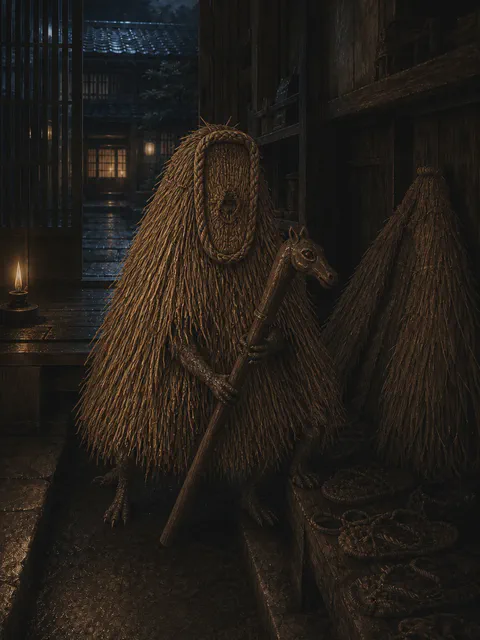
A yokai scroll in the Nichibun collection shows a sandal monster covered in yellow straw, with a straw sandal for a face, riding a horse-head staff. It is stranger than the one-eyed singing sandal of modern books, and it comes with no story.