
Biwa-bokuboku: The Blind Priest Whose Head Is a Lute
琵琶牧々(びわぼくぼく) Biwa-bokuboku ASCII: Biwa-bokuboku
Pronunciation: BEE-wah boh-koo-BOH-koo
In 1784 Sekien drew a blind biwa priest with a biwa for a head, feeling his way under a willow. His caption names two legendary court lutes, Genjō and Bokuba, and builds the creature's name out of one of them.
Quick Facts
- Habitat
- Road, House
- Region
- unspecified
- Recorded period
- Toriyama Sekien's Hyakki Tsurezure Bukuro (1784)
- Nature
- Unknown
- Danger rating
The danger rating is an editorial summary made for readability. It is not an objective measure found in folklore sources.
Watch the Short
What is Biwa-bokuboku?
A biwa is a Japanese lute: a short-necked, pear-shaped instrument played with a large plectrum. Bokuboku is a sound-play on a name. Put together, Biwa-bokuboku is an old lute that has started to walk.
It comes from Hyakki Tsurezure Bukuro, first published in 1784 — the last of Toriyama Sekien’s four illustrated yokai collections, devoted almost entirely to household objects and instruments turned into creatures.
The figure
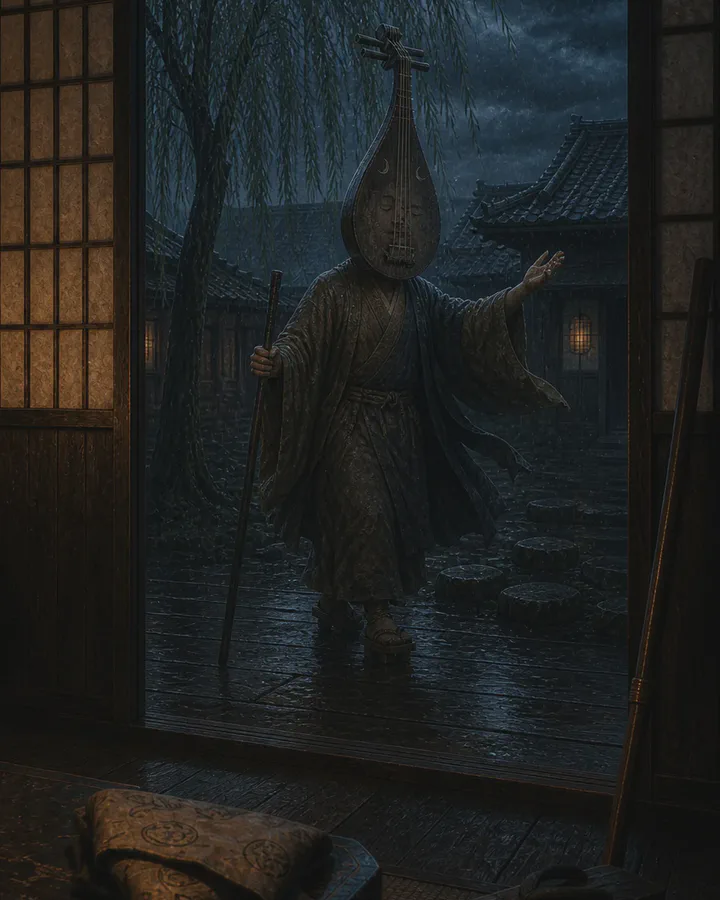
The plate shows a body dressed in robes, wearing high two-toothed geta. Where the head should be, there is a biwa. The eyes are closed. The right hand holds a staff; the left reaches forward, feeling the way. Behind it, a willow bends in the wind, and its robe blows the same way.
A study of Sekien’s work published by Osaka University reads the figure as a biwa hōshi — a blind priest-musician, one of the travelling reciters who had performed tales to the biwa since the Heian period. The staff, the searching hand, and the closed eyes all belong to that figure. Sekien has drawn a blind musician and made him into his instrument.
The caption: two famous lutes
Sekien’s text begins with two names. Genjō and Bokuba were celebrated biwa of the imperial court, treasures handed down from antiquity, and they were said to have caused strange things to happen again and again.
Genjō in particular gathered stories: of escaping a palace fire by itself, of being stolen by a demon and heard playing from the top of a city gate.
Then comes the play on words. Bokuba — 牧馬, “pasture horse” — becomes bokuboku, 牧々. Sekien wonders whether this is where the name comes from, and ends, as every entry in this book ends, by saying he thought so in a dream.
Appearance
A lute for a head, a priest’s robes, geta, a staff, closed eyes, and a hand reaching into the air ahead.
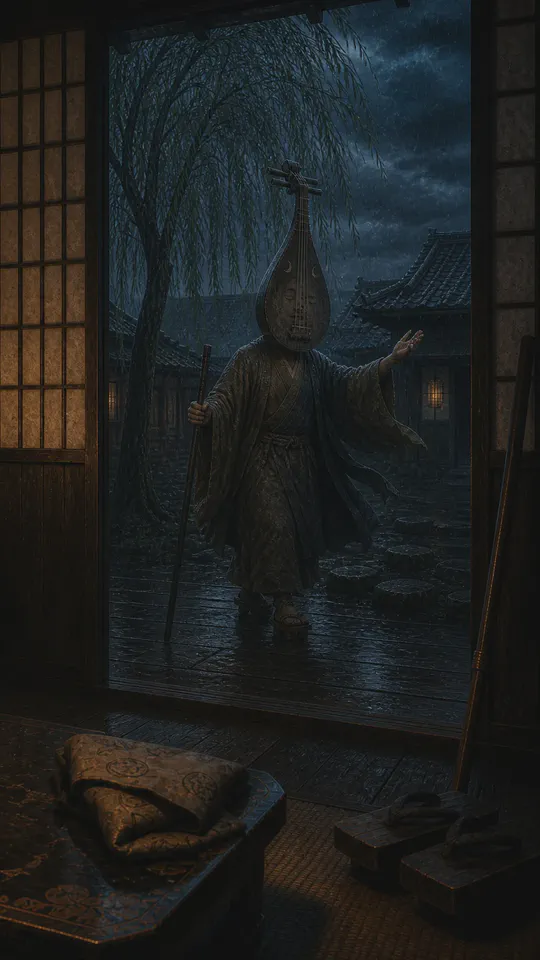
Our illustration follows the plate and adds rain: the figure walking past an open doorway at night, staff in hand, the lute’s neck rising where a head would be.
Behavior and abilities
- It walks. It is going somewhere, feeling its way.
- It carries the memory of famous music. That is what the caption’s two lutes supply — not an ability, but a history.
The source records no attack, no victim, and no incident.
Weaknesses and countermeasures
None are recorded. There is nothing in the plate that needs defending against — only an instrument that has become a traveller.
Documented plate and later imagery
Documented plate. Toriyama Sekien, Hyakki Tsurezure Bukuro, 1784: a figure with a biwa for a head, robed, in high geta, eyes closed, holding a staff and feeling ahead with the other hand, under a willow. The caption names the legendary court lutes Genjō and Bokuba, turns “Bokuba” into “bokuboku,” and closes on a dream.
Later readings. The Osaka study suggests a further layer. In Tsurezuregusa, the fourteenth-century essays of Yoshida Kenkō, Genjō goes missing during a court performance and a musician plays Bokuba in its place. On that reading, Sekien’s walker is the lost lute, still trying to find its way back. The caption itself does not say so.
What it does say is enough. An old instrument that once belonged to an emperor has taken the shape of the blind men who carried biwa music along every road in Japan, and it is walking in the wind with its eyes shut.
Sources and further reading
- Library Hyakki Tsurezure Bukuro (百鬼徒然袋), 3 volumes (external link) National Diet Library Search Bibliographic record for an 1805 printing; notes the original edition of 1784.
- Museum Hyakki Tsurezure Bukuro, middle volume (external link) Kawasaki City Museum Archive The middle volume, carrying Koto-furunushi and Biwa-bokuboku, Kyōrinrin, and Boroboroton with Hahakigami.
- Library Hyakki tsurezurebukuro digitized copy, volume 2 (external link) Smithsonian Libraries Digitized middle volume of Sekien's 1784 book of utensil yokai.
- Academic paper Toriyama Sekien's Gazu Hyakki Yagyō: background and contents (external link) Jörg Ebenschwanger; Bunka/Hihyō 1 (Osaka University), 2009 Notes that most of the fifty-one entries in the first collection carry a name and little or no explanatory text. Also reads the Biwa-bokuboku plate as a blind biwa priest feeling his way, with a proposed link to the Tsurezuregusa episode of the lost Genjō.
Related yokai
Tenome
手の目(てのめ)
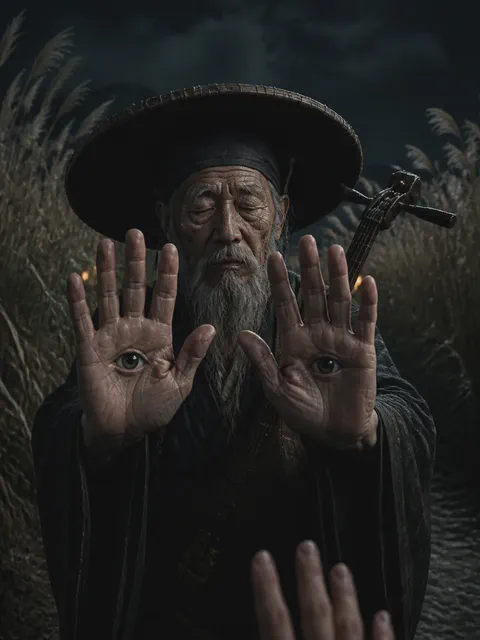
Sekien's 1776 plate shows an elderly blind figure with a biwa on his back, holding out two palms, each with an open eye. He gave it a name and nothing more; the story of a murdered man hunting his killer came later.
Karakasa-kozō
唐傘小僧(からかさこぞう)
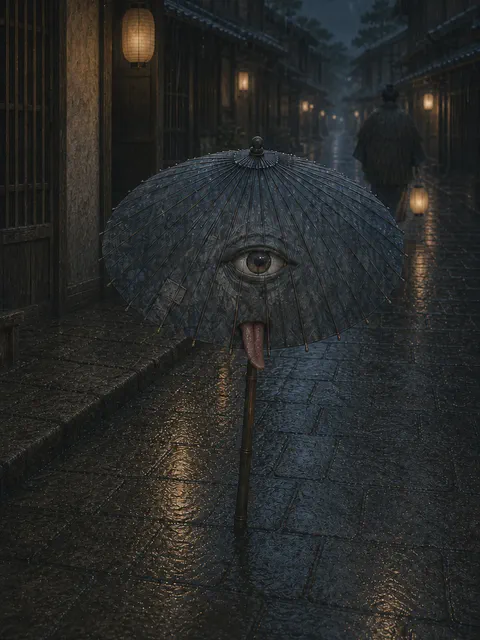
An 1857 Osaka print shows a kabuki actor playing a one-legged umbrella monster — the clearest history of a yokai known through pictures rather than encounters.