Betobeto-san: Footsteps With No Walker
べとべとさん(べとべとさん) Betobeto-san ASCII: Betobeto-san
Pronunciation: beh-toh-beh-toh-sahn
On a night road in Uda you hear a bita-bita footfall coming along behind you. There is nobody there. Step aside, say the words, and it stops — which is the entire record.
Quick Facts
- Habitat
- Road
- Region
- Uda district, Yamato
- Recorded period
- recorded in the Sōgō Nihon Minzoku Goi (1956)
- Nature
- Neutral
- Danger rating
The danger rating is an editorial summary made for readability. It is not an objective measure found in folklore sources.
Watch the Short
What is Betobeto-san?
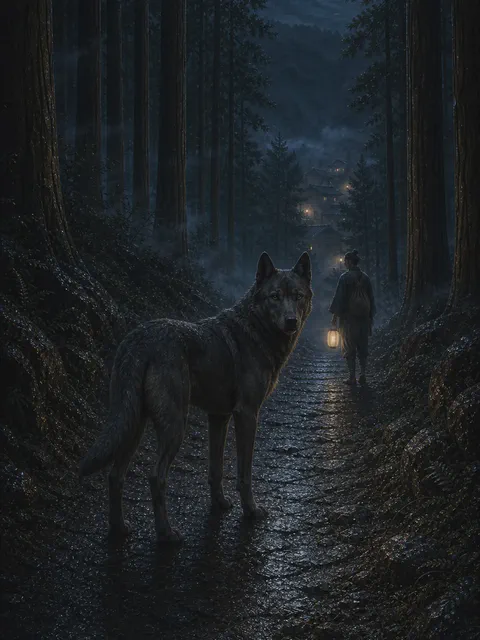
Walking alone at night in the Uda district of Yamato, you hear footsteps behind you. The record gives the sound as bita-bita — a wet, flat, unhurried footfall, keeping pace.
You turn around. There is nobody there.
You keep walking. It keeps following.
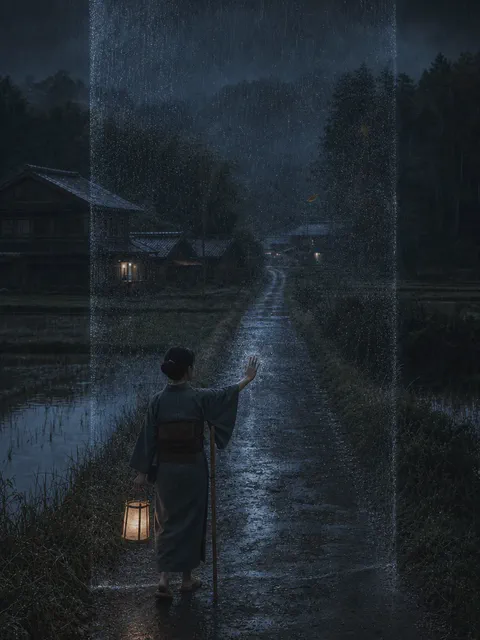
Then you step to the side of the road, out of the way, and say: Betobeto-san, please go ahead.
And after that there are no more footsteps.
Behavior and abilities
- It follows. That is the entire observed activity.
- It makes a sound and nothing else. No shape, no touch, no cold, no light.
- It cannot be seen. Turning around produces an empty road every time.
- It yields. Step aside, address it, and it passes.
Appearance
There is none. This needs saying plainly because it is the most unusual thing about the entry.
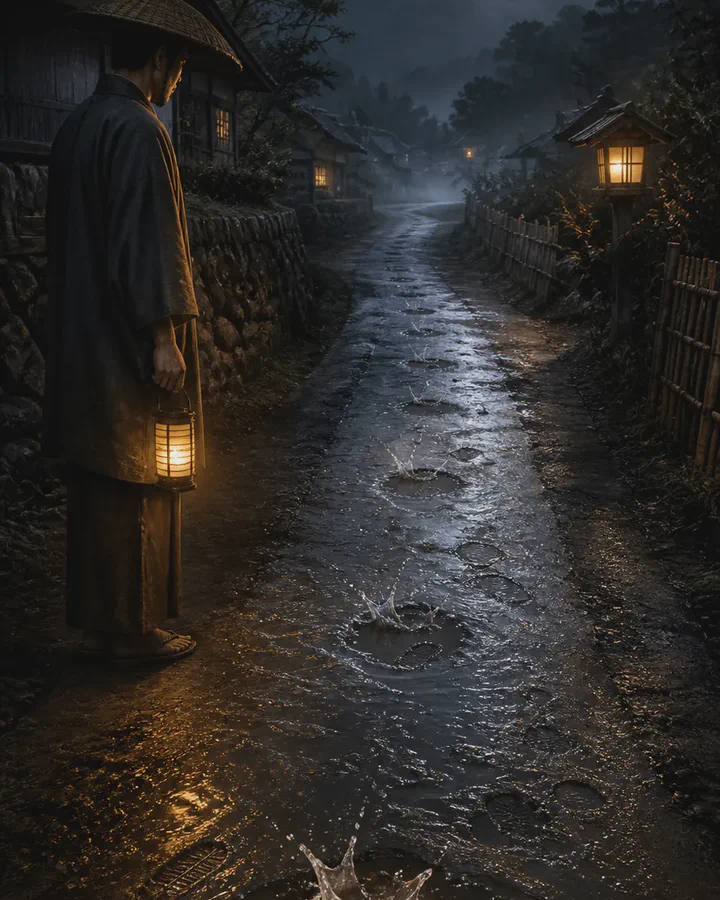
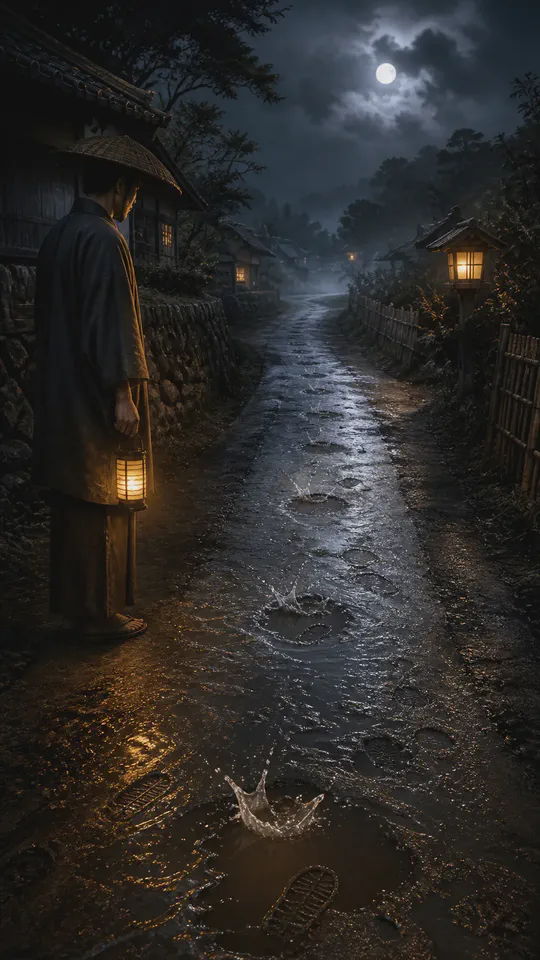
The record contains no body, no face, no size, and no colour. What was written down was a sound on a road and a sentence that stops it. Our illustration therefore shows a man who has stepped aside, an empty lane, and splashes rising from the puddles in a line moving away — which is as close to a portrait as the source allows.
The round smiling ball with two feet that most people picture today is a later creation and a good one. It is simply not in the record.
The sentence
Betobeto-san, saki e okoshi. Betobeto-san, please go ahead.
Two things about it are worth noticing.
It has a name in it. The thing is addressed as -san, the ordinary polite suffix, as though it were a neighbour on the road rather than a horror. Whoever first said this had already decided what kind of situation they were in.
It is a request to overtake, not to leave. Nobody is banishing anything. The formula assumes the road is shared and that the problem is one of order — you are in front, it is behind, and that arrangement is uncomfortable. Standing aside fixes it.
Weaknesses and countermeasures
One sentence, and it works.
That is genuinely rare in this collection. Most entries record no defence at all, and the ones that do usually offer a charm, a ritual, or a piece of luck. Here the countermeasure is a line of ordinary speech, spoken politely, and the record states that it ends the encounter.
It is tempting to build a character out of that — a harmless creature, a courteous one, a yokai that only wants to get past. The source does not go there, and neither will this page. What is recorded is a behaviour and a remedy. The disposition behind them is an inference, and an appealing inference is still an inference.
Where the record comes from
The tradition is summarised in the folklore database of the International Research Center for Japanese Studies, which cites the Sōgō Nihon Minzoku Goi of 1956. That is the date of the dictionary, not of the belief — the practice was collected then, and how long people had been stepping aside on that road before someone wrote it down is not something the citation can tell us.
Documented record and later imagery
Documented record. Uda district in Yamato: walking alone at night you may hear a bita-bita footfall as though someone were following; step out of the road and say “Betobeto-san, please go ahead,” and the footsteps cease. Recorded in the Sōgō Nihon Minzoku Goi, 1956.
Later imagery. Betobeto-san now has a face. Popular illustration gave it a rounded body, an enormous grin and a pair of feet, and that version travels well — it is funny, it is merchandisable, and it makes the politeness of the formula into a joke.
The recorded version is not funny. It is footsteps in the dark that match your pace and stop when you stop, on a road with nobody else on it, and the only thing anyone ever knew to do about it was stand aside and speak to it as though it were a person.
Sources and further reading
- Fieldwork collection Betobeto-san, card C0410979-000 (external link) International Research Center for Japanese Studies Uda district, Yamato. Walking alone at night you hear a bita-bita footfall behind you; step aside and say "Betobeto-san, please go ahead" and it stops. Sourced to the Sōgō Nihon Minzoku Goi of 1956.
- Academic paper On the use and embellishment of folk tradition in Mizuki Shigeru's work Aichi Gakuin University Repository Quotes the Sōgō Nihon Minzoku Goi entry and separates the recorded tradition from what later popular versions added.