Bakeneko: The Cat Yokai That Learns Human Ways
化け猫(ばけねこ) Bakeneko ASCII: Bakeneko
Pronunciation: bah-keh-NEH-koh
Stories of old cats that speak, perform, dress like people or take human form—and the separate cat yokai they keep getting confused with.
Quick Facts
- Habitat
- House
- Region
- Japan, Ishikawa, Miyagi, Okinawa
- Recorded period
- early modern imagery, modern folklore collections
- Nature
- Mixed
- Danger rating
The danger rating is an editorial summary made for readability. It is not an objective measure found in folklore sources.
Watch the Short
What is Bakeneko?
Bakeneko literally means a transformed or uncanny cat. The name does not describe one species with a fixed body and a universal set of powers. Instead, it gathers together stories, beliefs and images in which a cat—often one that has lived for many years—begins to cross the boundary between animal and human.
The transformation may be physical. A cat can take the appearance of a person or stand upright in human clothing. It may also be revealed through behavior: speaking, reciting a performance, dancing, or otherwise doing something that an ordinary household cat should not be able to do.
Conditions differ from place to place. Age is important in several records, but there is no single nationwide rule for how many years a cat must live before it changes. Size, color and other details found in individual tales should likewise not be treated as a universal bakeneko checklist.
Appearance
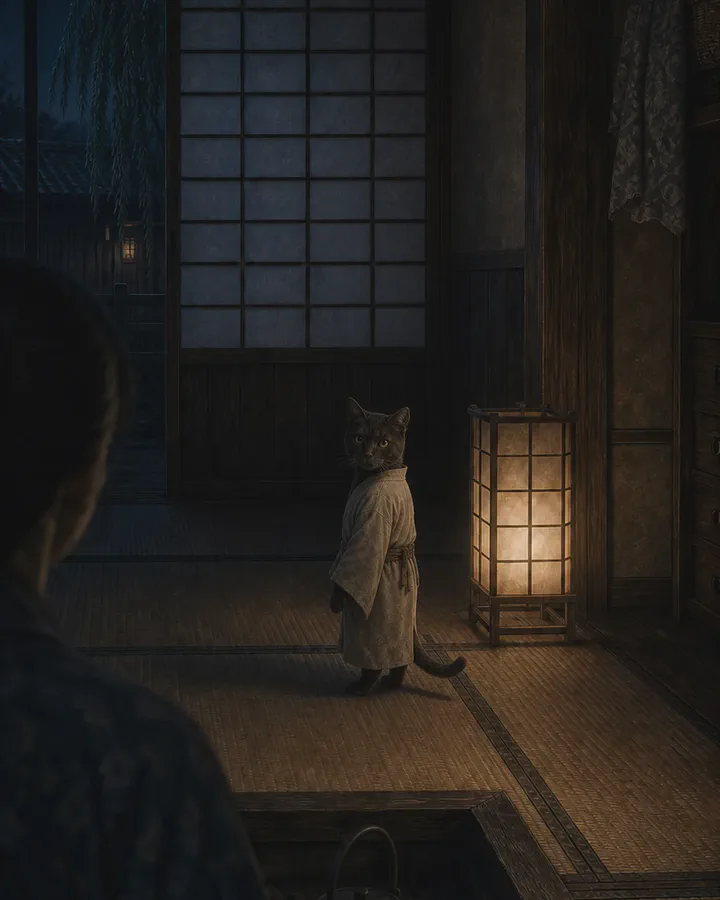
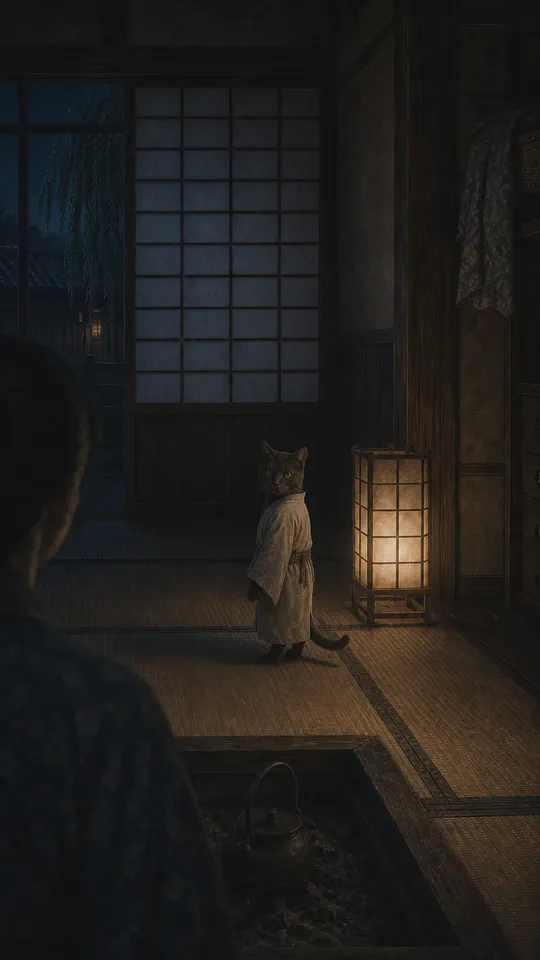
A bakeneko may look completely ordinary until the moment its hidden ability is noticed. That makes the familiar household cat—not a giant monster—the most important starting image. The uncanny detail can be as small as a human voice, an upright shadow, or clothing where no clothing should be.
Historical visual culture also made the transformation more explicit. Images catalogued by the International Research Center for Japanese Studies show cats standing in human dress and groups of transformed cats dancing together. Such pictures demonstrate that human clothing and performance became established ways to make a supernatural cat readable on the page.
The split or doubled tail belongs to the nekomata, a separate category of supernatural cat. Give a bakeneko two tails and you have drawn something else. The two traditions overlap in popular culture, but using two tails as the defining sign of every bakeneko erases a useful distinction.
Behavior and abilities
Folklore records preserve several kinds of transformation. A belief collected in Nanao, Ishikawa Prefecture, says that cats may become bakeneko as they grow old. Material from Okinawa similarly connects age with a cat gaining the power to transform.
One especially vivid account comes from Tashiro Island in Miyagi Prefecture. It describes a cat kept for thirty years that recited jōruri, a form of dramatic narrative performance, and took the form of a warrior. The importance of this record is not that thirty years became a rule for every cat. It shows how speech, performance and human disguise could all belong to one local bakeneko story.
Other tales and images make transformed cats dance, wear clothes or imitate the social world around them. Some bakeneko are dangerous, while others are primarily astonishing or unsettling. Murder, corpse manipulation and attacks on owners appear in famous cat-monster fiction, but they are not shared by every record placed under the bakeneko name.
Folklore accounts and changing images
Supernatural-cat traditions developed through an exchange between local belief, printed entertainment, visual art and theater. The National Diet Library’s exhibition on cats in Japanese books shows how widely cats moved through literature and popular imagery. Within that larger history, the bakeneko could be frightening, comic, theatrical or strangely human.
The famous cat-monster stories associated with Saga are an important part of popular culture, but their relationship to domain politics, theater and later retellings needs to be kept visible. The revenge plot belongs to those particular tales, not to every transformed cat in Japan.
This variety also explains why bakeneko imagery can change tone so quickly. A cat in a dark household may create quiet horror; a procession of cats dancing in costume may feel playful or satirical. Both can belong to the visual tradition without proving that all bakeneko behave the same way.
Weaknesses and countermeasures
No single weakness or protective method is documented across bakeneko traditions. A solution that works in one revenge tale cannot be assumed to apply to a household cat that speaks, performs or changes shape in another region.
The same caution applies to transformation conditions. Avoiding a particular age, weight or coat color is not a reliable countermeasure. Those details belong to particular beliefs, not to a consistent natural history.
Traditional folklore and later imagery
Documented tradition. Records from several regions connect old cats with supernatural transformation. Abilities include taking human form, speaking or performing like a person. Historical images also show transformed cats wearing clothes and dancing. The cited examples do not establish one age, appearance, temperament or weakness for every bakeneko.
Later imagery. Modern horror and fantasy often combine bakeneko with nekomata, revenge-cat drama, giant monster cats and standardized magical abilities. Those inventions can be compelling, but they are not a substitute for the varied record. Our short uses one elderly, single-tailed household cat, a plain kosode and an upright shadow to focus on the moment familiar behavior becomes impossible.
Sources and further reading
- Fieldwork collection Cat and bakeneko belief from Nanao, Ishikawa, record 1230533 (external link) International Research Center for Japanese Studies A local belief connecting an aging cat with transformation into a bakeneko.
- Fieldwork collection Thirty-year-old cat account from Tashiro Island, record 2240078 (external link) International Research Center for Japanese Studies Describes a long-kept cat reciting jōruri and transforming into a warrior.
- Fieldwork collection Bakeneko belief from Okinawa, record 0640356_003 (external link) International Research Center for Japanese Studies A regional example associating age with a cat gaining the power to transform.
- Museum Bakeneko standing in human clothing (external link) International Research Center for Japanese Studies Catalogue record for a historical image of a transformed cat in human dress.
- Museum Image of nine dancing bakeneko (external link) International Research Center for Japanese Studies Catalogue record demonstrating the dancing-cat motif in historical imagery.
- Library Cats Everywhere in Books (結構毛だらけネコ本だらけ) (external link) National Diet Library Exhibition surveying cats in Japanese books and popular visual culture.
Related yokai
Rokurokubi
轆轤首(ろくろくび)
A seemingly human figure whose neck stretches at night—and one name that once covered more than one uncanny form.