
Bake-danuki: Shukaku and the Kettle That Never Ran Dry
化け狸(ばけだぬき) Bake-danuki ASCII: Bake-danuki
Also known as: 守鶴, 分福茶釜, 文福茶釜
Pronunciation: bah-keh dah-noo-kee
Morinji tradition tells of the monk Shukaku, an inexhaustible iron kettle, and the mujina or tanuki form revealed while he slept.
Quick Facts
- Habitat
- Temple shrine, House
- Region
- Tatebayashi (Gunma)
- Recorded period
- Morinji temple tradition, 1570 and 1587, Meiji and Taishō fairy-tale adaptations
- Nature
- Helpful
- Danger rating
The danger rating is an editorial summary made for readability. It is not an objective measure found in folklore sources.
Watch the Short
What is a Bake-danuki?
Bake-danuki is a broad modern label for supernatural or transforming tanuki. The animals involved are Japanese raccoon dogs, not the raccoons of North America. Folklore gives them many roles: tricksters, imitators, benefactors, monks, household visitors, and sources of uncanny sound. No single story defines every bake-danuki.
This page centers on Morinji, a Sōtō Zen temple in Tatebayashi, Gunma Prefecture, and its tradition of Shukaku. According to the temple, Shukaku came to the region with the founding monk Dairin Shōtsū and served successive abbots. For a gathering of one thousand people in 1570, he supplied an iron kettle whose hot water did not run out.
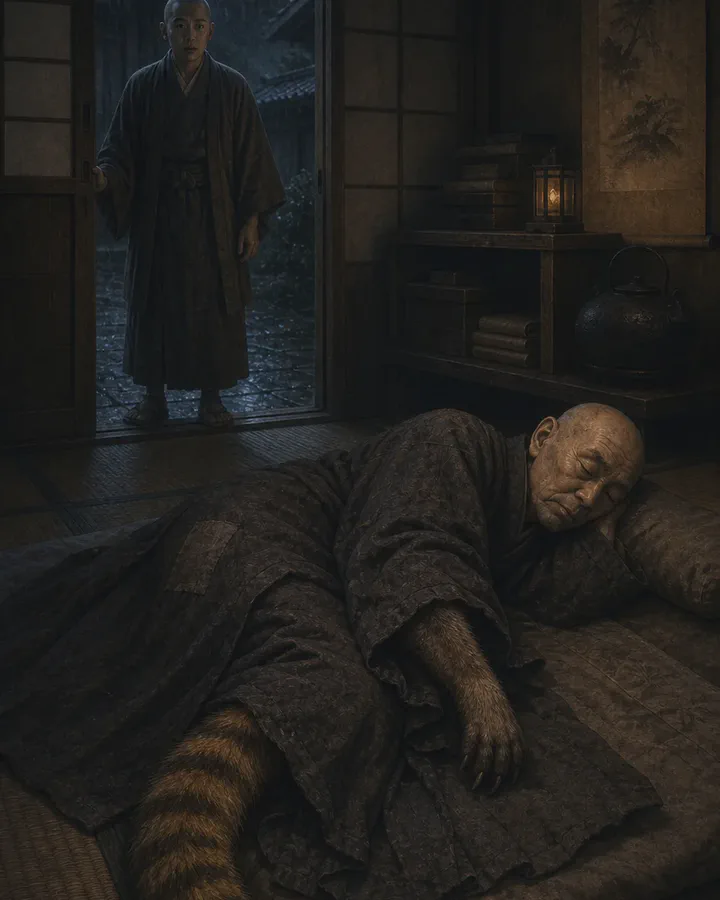
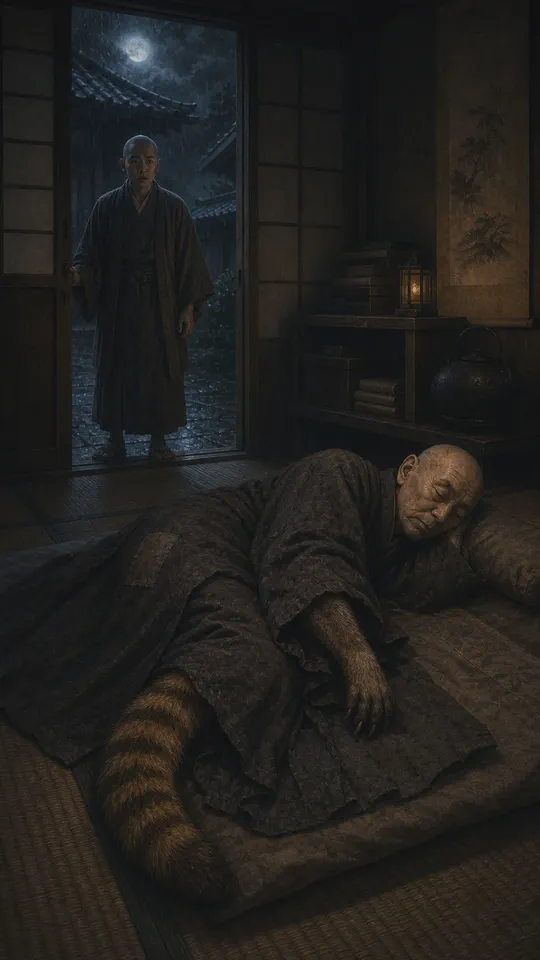
Years later, Shukaku slept so deeply that fur appeared on his hands and feet and a tail became visible. The temple describes his true body as a mujina, with a tanuki given as another version. Once discovered, he decided to leave. Morinji dates his departure to 28 February 1587, after 161 years associated with the temple’s founding community.
Appearance
The Morinji account first presents Shukaku as a monk, not as a kettle with a face. His supernatural identity is exposed through the sleeping body: furred limbs and a tail appear where people expected an ordinary human form.
The wording matters. Mujina has not always named one zoologically precise animal in Japanese usage, and the temple itself notes a tanuki version. It is therefore safer to preserve both terms than to claim that every telling agrees on a single species.
Our illustration shows an elderly monk in a patched brown robe, a naturalistic Japanese tanuki form, and a plain black iron kettle. The kettle has no eyes, face, paws, tail, or balancing rope. Those choices follow the temple tradition featured in the short rather than the best-known children’s-book image.
The setting is an invented late-sixteenth-century temple interior. It evokes the period of the account but does not reconstruct Morinji’s present buildings or claim that the visual design is an eyewitness record.
Behavior and abilities
Morinji’s tradition attributes several extraordinary acts to Shukaku:
- Long service in human form. He lives and works among successive generations of monks.
- The inexhaustible kettle. At the 1570 gathering, its hot water continues to serve a large number of guests without running dry.
- A promise of shared fortune. The temple says Shukaku associated the kettle’s water with eight benefits, including good fortune and long life.
- Revelation during sleep. Fur and a tail expose the body concealed beneath the monk’s appearance.
- A final display before departure. The temple tradition says he showed scenes of the Genpei battle at Yashima and the Buddha’s preaching before leaving in his animal form.
Our thirty-second video includes the service, kettle, sleeping revelation, and departure. It omits the two final visionary scenes so they are not reduced to unreadable flashes or confused with powers belonging to every tanuki story.
Nothing in the adopted temple account requires Shukaku to attack the monks. Discovery ends a long relationship, but the story remembers what he gave the community as clearly as the secret body he concealed.
The temple tradition and the dancing kettle
The famous image of Bunbuku Chagama often shows a kettle sprouting a tanuki’s face, paws, and tail and performing for an audience. That is not the same scene as Morinji’s account of Shukaku.
Morinji explains that the temple tradition was later published as the fairy tale Bunbuku Chagama by Iwaya Sazanami in the Meiji and Taishō periods. In that later popular form, the animal-kettle performs feats such as tightrope walking. A folklore record published in 1935 preserves another story shaped by the performance version: a transformed kettle passes through the hands of a dealer and becomes a successful attraction.
These versions are part of the tradition’s history, but they change its center. The temple narrative follows a monk who brings a useful kettle and is later revealed as nonhuman. The fairy tale foregrounds the entertaining animal-kettle. Treating one as a literal illustration of the other makes both harder to understand.
Weaknesses and countermeasures
The Morinji account provides no universal weakness for Shukaku or for bake-danuki in general.
Sleep exposes his concealed body, but the story does not describe sleep as a weapon, ritual, or reliable way to defeat transforming animals. Nor does the temple prescribe fire, dogs, iron, Buddhist objects, or magic words as defenses. The monks do not battle or imprison Shukaku after his discovery.
Because the central figure has served the community and shared the kettle’s benefits, a list of combat weaknesses would distort the story. Its tension is the ending of trust after a secret identity becomes visible.
Temple tradition and later imagery
Temple tradition. Morinji identifies Shukaku as a long-serving monk who provides the inexhaustible kettle in 1570, reveals a mujina or tanuki body in his sleep, and leaves in 1587. The kettle is a separate iron object associated with shared good fortune.
Later fairy-tale imagery. Meiji- and Taishō-period publication helped spread the comic performing kettle with an animal face and limbs. Other retellings add rescue, sale to a dealer, public performance, or a return to the temple.
Our short follows Morinji’s Shukaku rather than making the kettle itself the creature. The lasting question is not how to defeat him, but how to remember a nonhuman visitor who concealed his identity while giving something valuable to the people around him.
Sources and further reading
- Primary text Bunbuku Chagama and Morinji (external link) Sōtō Zen Morinji Temple Morinji's official account of Shukaku, the inexhaustible kettle used in 1570, his revealed mujina or tanuki form, his 1587 departure and the later fairy tale.
- Primary text History of Morinji (external link) Sōtō Zen Morinji Temple The temple's history connecting founder Dairin Shōtsū, Shukaku and Morinji's establishment in Tatebayashi.
- Fieldwork collection Bunbuku Chagama and related tanuki accounts, record 1232860 (external link) International Research Center for Japanese Studies A 1935 Gunma record and related examples showing how the performing-kettle tale and the Shukaku temple tradition developed in distinct retellings.
Related yokai
Bakeneko
化け猫(ばけねこ)
Stories of old cats that speak, perform, dress like people or take human form—and the separate cat yokai they keep getting confused with.
Nekomata
猫又(ねこまた)
A 1931 Kagawa record describes an aging cat whose tail divides in two and that rises to dance on its hind legs.
Zashiki-warashi
座敷童子(ざしきわらし)
In Tōno Monogatari, an unfamiliar child crosses the corridor of an old house — and the family that shelters the spirit is said to prosper.