
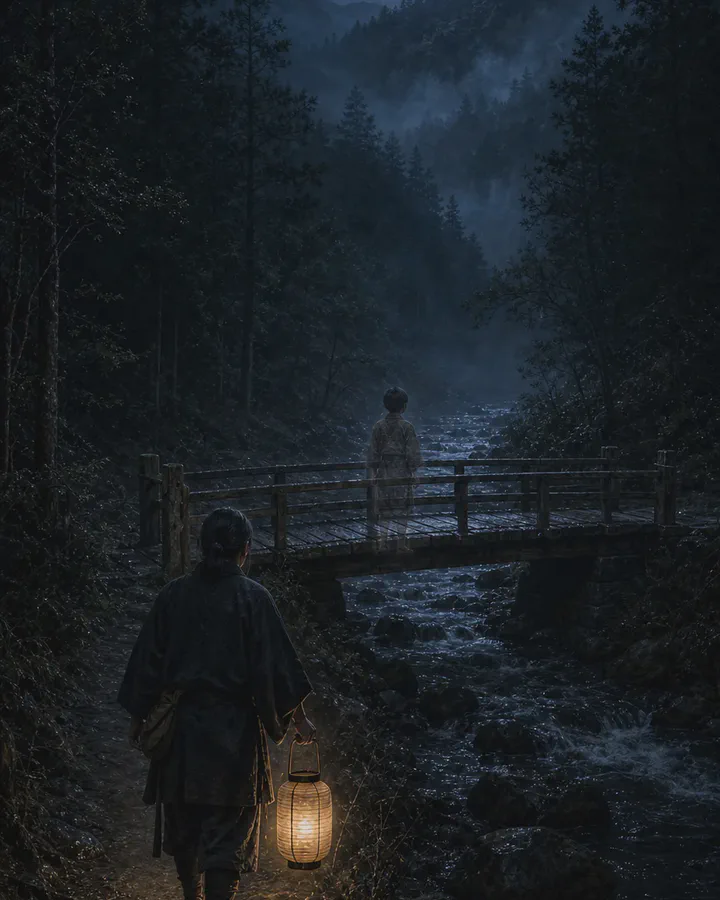
Azuki-arai: The Yokai Heard Beside the Water
小豆洗い(あずきあらい) Azuki-arai ASCII: Azuki-arai
Also known as: 小豆とぎ
Pronunciation: ah-zoo-kee ah-rye
A bean-washing sound repeats beside a dark stream, but the person making it cannot be found.
Quick Facts
- Habitat
- River, Mountain
- Region
- Kitasaku (Nagano), Suwa (Nagano), Ehime, Ōita
- Recorded period
- 1938 folklore record, 1943 folklore records, modern folklore collections
- Nature
- Unknown
- Danger rating
The danger rating is an editorial summary made for readability. It is not an objective measure found in folklore sources.
Watch the Short
What is Azuki-arai?
Azuki-arai means “azuki-bean washer.” The name describes a strange sound heard near water: a steady shaki-shaki or rustling rhythm like red beans being washed in a basket. In many accounts, the sound is more important than anything that can be seen.
The account featured in our short video was published in 1938 and catalogued for Kitasaku District in Nagano Prefecture. People heard a sound like azuki beans being washed at the water’s edge and said that a bakemono — a strange or supernatural being — was making it. The record does not provide a visible body, a victim, or an attack.
That absence is the heart of the encounter. A familiar household sound appears where no ordinary work should be happening, and approaching the water does not necessarily reveal its cause.
Appearance
Azuki-arai does not have one fixed appearance across Japan.
The 1938 Kitasaku record centers on sound and does not describe the being’s body. It therefore cannot establish that Azuki-arai is always an old man, an old woman, a child, an animal, or a visible bean washer. Illustrations that show a basket and red beans turn the sound into a readable image; they are not proof that witnesses saw those objects.
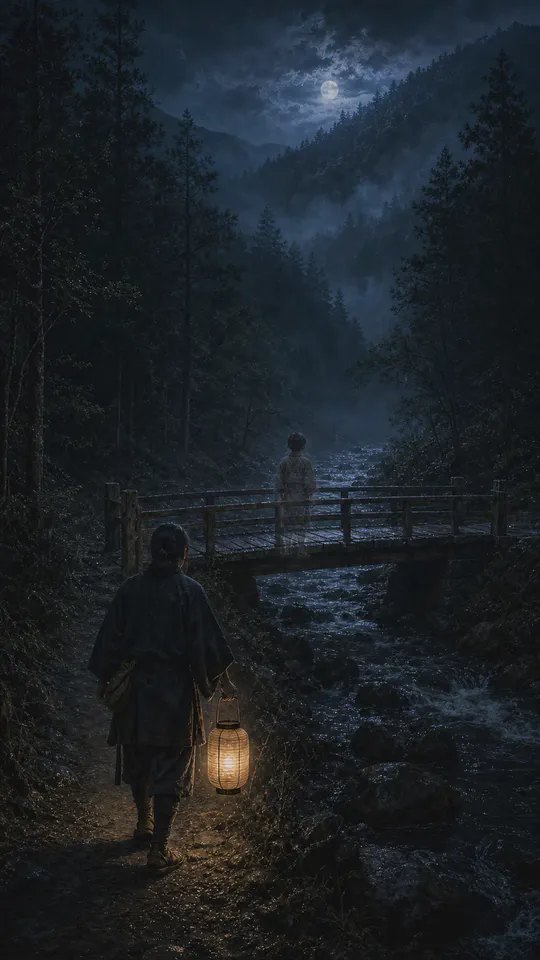
A separate account published in 1943 and associated with Suwa, Nagano, describes an old man meeting a boy at night. The pattern of the child’s clothing could be seen even in the darkness. When the man spoke to him, the boy disappeared. On the return journey, the old man heard the repeated sound of azuki beans being washed at the same place.
Our illustration draws on that Suwa account. The boy wears a subdued patterned robe and fades into stream mist as a traveler raises his hand. This is one regional narrative image, not a universal portrait of Azuki-arai.
Behavior and abilities
The documented behavior is restrained:
- A repetitive sound comes from the water. It resembles beans rubbing together while being washed.
- The cause may remain unseen. In the Kitasaku example, the record describes the noise and the belief that a strange being made it, not a visible washer.
- A humanlike figure may appear in a separate account. In the Suwa story, a boy vanishes when addressed, and the bean-washing sound is heard later.
- The encounter creates uncertainty rather than a documented attack. The adopted records do not say that Azuki-arai eats the traveler, drags them into the water, or causes a drowning.
Some later summaries attach threatening songs, falls into the water, or other consequences to similarly named traditions. Those motifs have local sources of their own. The two Nagano records contain none of them.
Folklore accounts and regional variations
Names related to Azuki-arai or Azuki-togi appear in multiple regions, often near rivers, streams, wells, or bridges. The shared motif is the sound of washing beans, but the identity of the sound-maker and the surrounding story can differ.
A 1943 Nagano record describes an Azuki-arai wearing a black cloth over its head. This is useful evidence of a visible regional form, but it does not retroactively give that appearance to the sound-only Kitasaku account.
An Ehime record published in 1978 places the sound beneath a bridge on a rainy night. An Ōita record published in 1986 again emphasizes that the source cannot be seen. Together, these examples show a durable pattern — an ordinary working sound displaced into darkness and an uncertain waterside space — without proving one nationwide biography.
Related names such as Azuki-baba, Azuki-togi-baba, or regional animal forms should also be handled carefully. Similar names and sounds can connect traditions, but they do not automatically make every figure the same yokai with the same age, body, and behavior.
Weaknesses and countermeasures
No consistent countermeasure is documented in the sources used for this article.
The Kitasaku record does not prescribe a charm, spoken phrase, offering, or weapon. The Suwa account records a disappearance after the boy is addressed, but it does not establish that speaking is a universal method for defeating Azuki-arai. The old man still hears the sound on his way home.
Because the adopted material does not describe an attack, it would also be misleading to invent a combat weakness. The practical warning is the ordinary one that applies to any dark riverbank: do not treat an unexplained sound as a reason to step carelessly toward deep or fast-moving water.
Traditional folklore and later imagery
Documented tradition. A 1938 Kitasaku record describes a bean-washing sound at the water’s edge and a belief that a strange being makes it. A distinct Suwa account published in 1943 connects a vanishing boy with the same kind of sound. Other regional records move the motif beneath a bridge or keep the sound-maker invisible.
Later imagery. Modern depictions often turn the name into a single recognizable character holding a basket of red beans. Some make the figure comic; others add an old face, animal features, a threatening song, or a victim falling into the river. These designs can be effective visual shorthand, but they combine choices that the sound-centered records do not require.
Azuki-arai remains unsettling precisely because it may offer so little to see: dark water, a repeated domestic sound, and the feeling that someone has just stopped working beyond the edge of the lantern light.
Sources and further reading
- Fieldwork collection Azuki-togi and Azuki-arai account from Kitasaku, Nagano, record 2180714 (external link) International Research Center for Japanese Studies The adopted 1938 account: a sound like azuki beans being washed comes from the water's edge, where people say a strange being makes it.
- Fieldwork collection Azuki-arai and a vanishing boy from Suwa, Nagano, record 2181773 (external link) International Research Center for Japanese Studies A distinct account published in 1943: an old man meets a boy whose patterned clothing is visible in darkness; the boy disappears when addressed, and the bean-washing sound is heard on the return journey.
- Fieldwork collection Azuki-arai wearing a black head cloth, Nagano, record 2181770 (external link) International Research Center for Japanese Studies A visible regional form published in 1943; not the appearance given in the sound-only Kitasaku record.
- Fieldwork collection Azuki-washing sound beneath a bridge in Ehime, record 0200280 (external link) International Research Center for Japanese Studies A regional account published in 1978 that places the sound under a bridge on a rainy night.
- Fieldwork collection Unseen Azuki-arai account from Ōita, record C4410037-000 (external link) International Research Center for Japanese Studies A regional account published in 1986 in which the source of the bean-washing sound cannot be seen.
- Reliable secondary The origin of Azuki-arai — why does it wash azuki beans? (external link) National Diet Library Search Bibliographic record for a scholarly discussion of the bean-washing motif and its origins.
Related yokai

Kappa
河童(かっぱ)
A child-sized water yokai whose strength lives in the water held by the dish on its head.
Kodama
木霊(こだま)
Kodama can mean both a presence within an old tree and the echo that returns from a mountain — but Japanese tradition gives it no single fixed body.
Zashiki-warashi
座敷童子(ざしきわらし)
In Tōno Monogatari, an unfamiliar child crosses the corridor of an old house — and the family that shelters the spirit is said to prosper.