Ao-bōzu: The Blue Monk and the One Question
青坊主(あおぼうず) Ao-bōzu ASCII: Ao-bozu
Pronunciation: AH-oh BOH-zoo
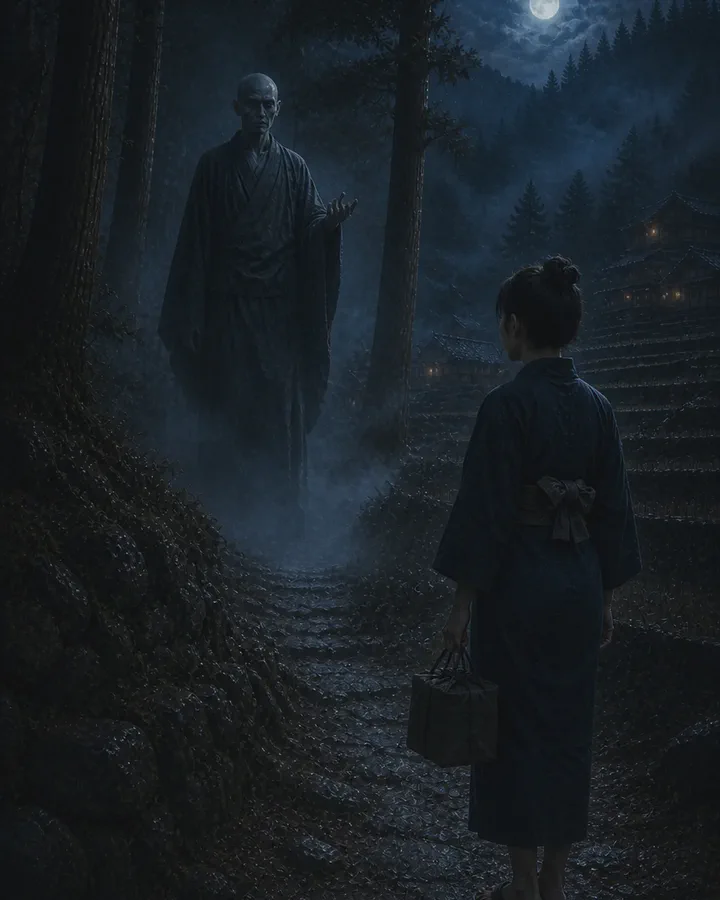
In a 1984 record from Miai in Kagawa, a girl carrying lunch to her family's mountain field met Ao-bōzu, the blue monk. He asked her one question. She said no, and he was gone.
Quick Facts
- Habitat
- Mountain, Road, Field
- Region
- Miai, Kotonami (Kagawa)
- Recorded period
- 1984 folklore record
- Nature
- Harmful
- Danger rating
The danger rating is an editorial summary made for readability. It is not an objective measure found in folklore sources.
Watch the Short
What is Ao-bōzu?
Ao is blue — in older Japanese, a colour that also covers green and the pallor of an unwell face. Bōzu is a Buddhist monk, or anyone with a shaved head. Ao-bōzu is the blue monk.
The name turns up in more than one place. Toriyama Sekien drew an Ao-bōzu in his 1776 Gazu Hyakki Yagyō, and other regions have their own. This article follows one record, from one village, because it is complete in itself.
The encounter in Miai
In 1984 the folklorist Takeda Akira published a collection of yokai and ghost stories from Miai, in what was then Kotonami in Kagawa prefecture, in the journal Kagawa no Minzoku. One of them is very short.
A girl was taking a packed lunch up to members of her household who were working in a field on the mountain. On the way, Ao-bōzu appeared.
He said: Kubi tsuran ka — “Won’t you hang yourself?”
She refused. And Ao-bōzu faded away and was gone.
That is the entire record.
Appearance
The record gives the name and nothing else — no height, no face, no colour beyond what the name implies, no time of day. The blueness is in the word ao, and whether it described his skin, his robes, or simply how he made people feel is not recorded.
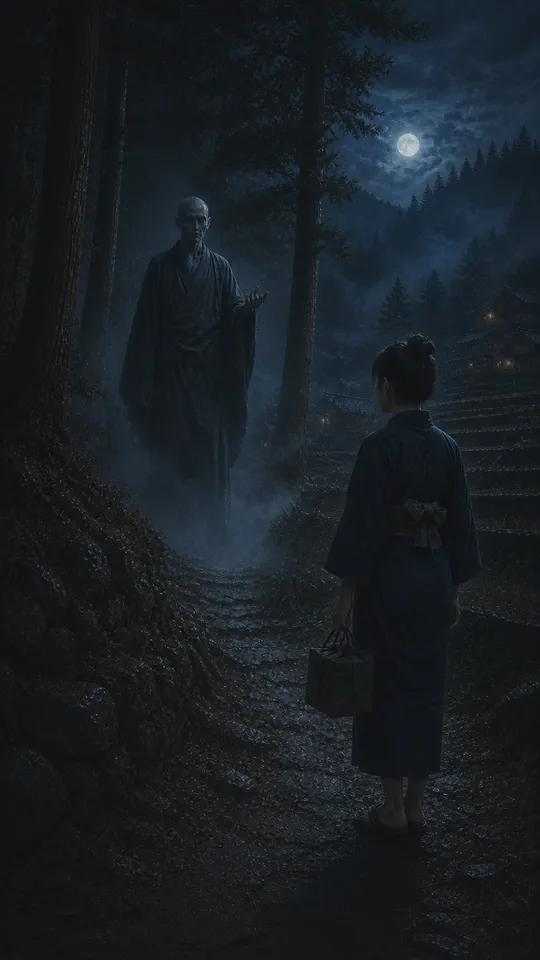
Our illustration gives him pale blue-grey skin and dark robes and puts the meeting on a forest path under the moon. Those are our choices. The record’s details are the lunch, the mountain field, the question, and the refusal.
Behavior and abilities
- He appears on the path. Not at a house, not at a shrine — on the way to somewhere, in the middle of an errand.
- He asks. He does not chase, grab, or threaten. He speaks one sentence, and it is a question.
- He vanishes when refused. The word in the record suggests fading out rather than running off.
Weaknesses and countermeasures
In this record, the answer “no” was enough. Nothing more was needed — no charm, no prayer, no running. The girl said she would not, and the blue monk was not there any more.
It is a strangely exact picture of what the danger was. Ao-bōzu had no power over her except the power of suggestion. The whole threat lay in whether she would agree.
Documented tradition and later imagery
Documented tradition. Takeda Akira, “Yokai and ghost stories of Miai, Kotonami, Nakatado district,” Kagawa no Minzoku 41 (1984), p. 4: a girl carrying lunch to family working in a mountain field meets Ao-bōzu, who asks “Won’t you hang yourself?” She refuses, and he disappears. The record includes no description, no origin, and no aftermath.
Later imagery. Modern yokai books tend to fold every Ao-bōzu together — Sekien’s plate and reports from other regions where he does different things. The result is a composite with a single appearance and a range of habits, none of which belongs to Miai.
The Miai record is two sentences long. There is a path, a lunch that someone is waiting for, a question nobody should be asked, and a girl who said no.
Sources and further reading
- Fieldwork collection Ao-bōzu, record 0470088 (external link) International Research Center for Japanese Studies Takeda Akira, "Yokai and ghost stories of Miai, Kotonami, Nakatado", Kagawa no Minzoku 41 (1984), p. 4. A girl carrying lunch to a mountain field is asked "Won't you hang yourself?"; she refuses and he vanishes.
- Library Gazu Hyakki Yagyō bibliographic record (画図百鬼夜行) (external link) National Diet Library Search Bibliographic record for Sekien's 1776 picture book.
- Library Toriyama Sekien's Illustrated Night Parade of the Demon Horde (external link) National Diet Library Image Bank Overview of Sekien's four illustrated collections, including the 1781 Konjaku Hyakki Shūi that carries the Shinkirō plate.
Related yokai
Yamauba
山姥(やまうば)
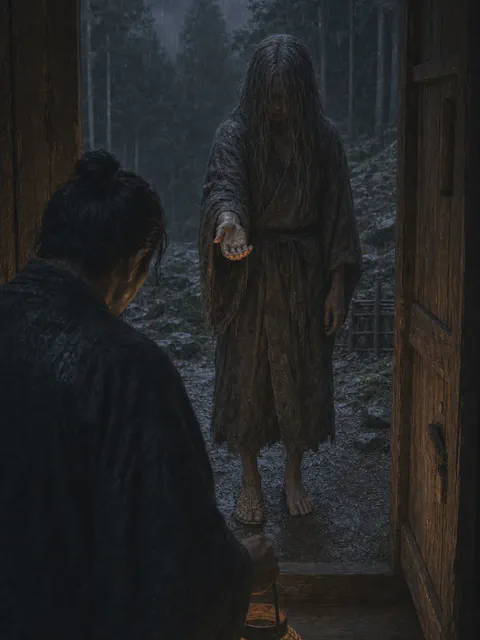
A man carries a woven object home from the hills, and that night a woman's voice demands the return of her ashinaka.
Mikoshi-nyūdō
見越入道(みこしにゅうどう)
A 1938 Nagasaki record warns of bamboo rustling over a night road and a looming figure that must be recognized aloud.
Umi-bōzu
海坊主(うみぼうず)
One account describes a vast Buddha-like shape crossing ahead of a boat on a clear, windless day, then slowly thinning until it vanished.