
Akaname: A Name, a Tongue, and No Explanation
垢嘗(あかなめ) Akaname ASCII: Akaname
Pronunciation: ah-kah-NAH-meh
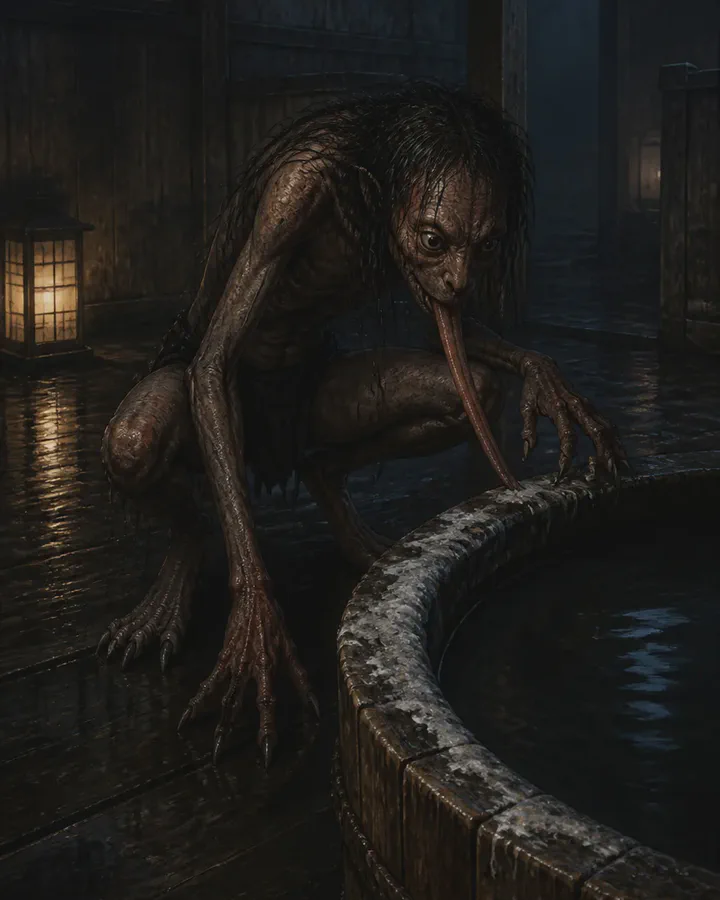
Sekien drew a crouching figure with a long tongue in a bathhouse in 1776 and called it the grime-licker. He wrote nothing else about it — and everything you have been told about dirty bathrooms was added afterwards.
Quick Facts
- Habitat
- House
- Region
- unspecified
- Recorded period
- Toriyama Sekien's Gazu Hyakki Yagyō (1776)
- Nature
- Neutral
- Danger rating
The danger rating is an editorial summary made for readability. It is not an objective measure found in folklore sources.
Watch the Short
What is Akaname?
Aka is grime — the film that builds up on skin, on wood, on the inside of a tub. Nameru is to lick. Akaname is the grime-licker.
In 1776 Toriyama Sekien included it in Gazu Hyakki Yagyō, his first illustrated collection. The plate shows a thin human-shaped creature crouched in what reads as a bathhouse, with a long tongue extended.
And that is the source. The complete source.
What Sekien did not write
Most entries in Sekien’s first collection carry a name and a picture and little or no explanatory text — it is a catalogue of images rather than a book of stories, and akaname is one of the many that arrives with nothing attached.
There is no account of where it lives, what it wants, whether it has been seen, what happens to a person who meets one, or what to do about it. There is a figure, a tongue, a bath, and a word.
This matters because the modern description is so confident. Akaname appears in dirty bathrooms. It is drawn to filth. Keep your bath clean or it will come. Its existence is a lesson about housekeeping.
None of that is Sekien’s. All of it is a reasonable thing to infer from a grime-licker in a bathhouse, and inference is what it remains.
Appearance
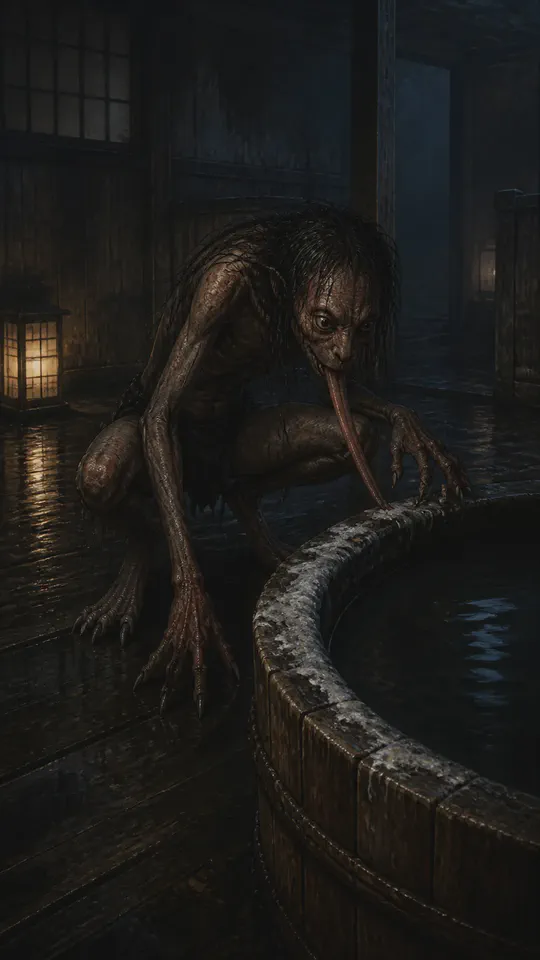
Our illustration follows the plate: a lean crouching figure, wet-haired, with long clawed fingers and a tongue reaching toward the rim of a wooden tub, in a bathhouse lit by one lantern.
The proportions are wrong on purpose — long limbs, a small body, a head too close to the floor. Sekien’s figure is human-shaped without being a human shape, and the tongue is doing what the name says.
Behavior and abilities
- It licks grime. This is the name and the picture and the entire recorded behaviour.
- It is in a bathhouse. Established by the setting of the plate, not by text.
- It has a long tongue. The one anatomical fact the image insists on.
That list has three items because the source has three things in it.
Weaknesses and countermeasures
None, and unusually there is not even a silence to interpret. Other entries in these files record no defence because nothing threatening happens. Here there is no record at all beyond a picture — no encounter, no witness, no aftermath, so nothing that could have a remedy.
The modern answer — clean the bath — is a countermeasure invented to match a threat that was itself invented to match a name.
Why the gap got filled
It is worth being fair to whoever filled it. A creature called grime-licker, drawn in a bathhouse, invites exactly one conclusion, and the conclusion is tidy: filth attracts it, cleanliness prevents it, and a household has a reason to scrub.
That reading turned akaname into one of the most recognisable yokai in Japan and gave it a job. It is genuinely useful and completely absent from 1776.
The thing worth preserving is the distinction, not the disapproval. Sekien drew a picture and gave it a name. Two and a half centuries of readers supplied the rest, and the supplying is itself part of the creature’s history.
Documented plate and later imagery
Documented plate. Toriyama Sekien, Gazu Hyakki Yagyō, 1776: a human-shaped creature with a long extended tongue, in a setting suggesting a wooden bath or bathhouse, under the name 垢嘗. No substantial explanatory text accompanies it, in common with much of that first collection.
Later imagery. Akaname is now firmly a bathroom creature with a stated habit and an implied moral. Modern collections describe it appearing in neglected baths at night to lick the residue, and the lesson attached is domestic.
The plate on its own is less useful and more unpleasant. Something is in the bathhouse. It is shaped roughly like a person. Its tongue is out, and the book does not say why.
Sources and further reading
- Library Hyakki Yagyō holding record (external link) Tokyo University of the Arts Library Library catalogue record for a copy of the picture book.
- Library Toriyama Sekien's Illustrated Night Parade of the Demon Horde (external link) National Diet Library Image Bank Overview of Sekien's four illustrated collections, including the 1781 Konjaku Hyakki Shūi that carries the Shinkirō plate.
- Academic paper Toriyama Sekien's Gazu Hyakki Yagyō: background and contents (external link) Jörg Ebenschwanger; Bunka/Hihyō 1 (Osaka University), 2009 Notes that most of the fifty-one entries in the first collection carry a name and little or no explanatory text. Also reads the Biwa-bokuboku plate as a blind biwa priest feeling his way, with a proposed link to the Tsurezuregusa episode of the lost Genjō.
Related yokai
Kawa-akago
川赤子(かわあかご)
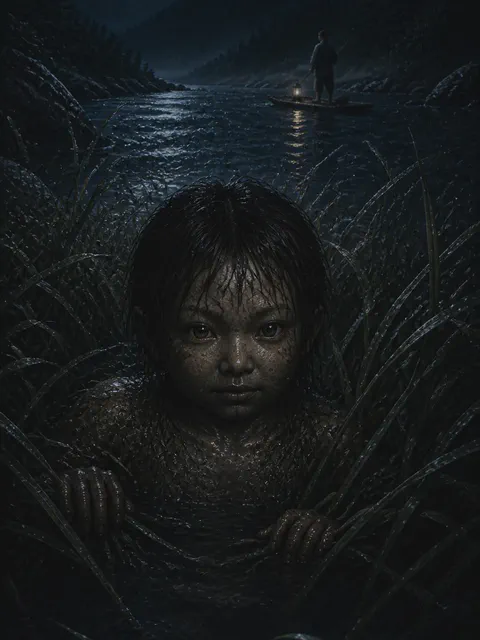
Toriyama Sekien drew an infant-shaped creature rising from the water plants of a mountain river in 1779, watching a man on a raft — and admitted in the caption that he was guessing about what it was.
Mokumokuren
目目連(もくもくれん)
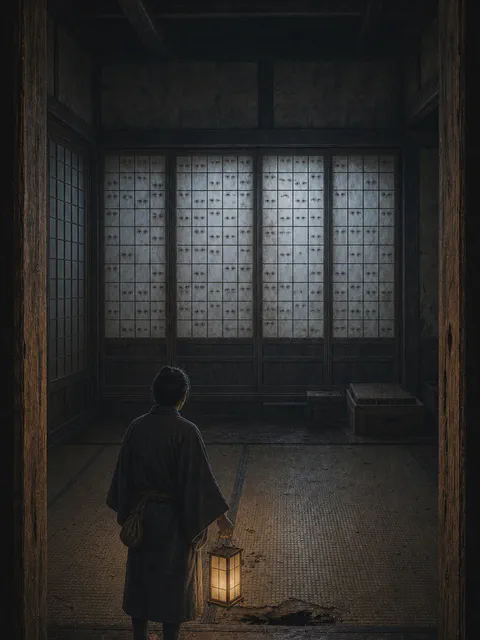
Rows of human eyes appear across old shoji in Toriyama Sekien's 1781 picture-book image.