
Aka Manto (赤マント): The Red Cloak of Tokyo, 1939
A rumour that swept the capital for a month, the police broadcast that denied it, and the toilet question that came fifty years later
赤マント(あかマント) Aka Manto ASCII: Aka-Manto
Also known as: Red Cloak, Akai Manto
Pronunciation: AH-kah MAHN-toh
Aka Manto (赤マント, “red cloak”) is the man in a red cloak of Japanese rumour. In late February 1939 the schoolchildren of Tokyo passed on the story that a hunchbacked man in a red cloak appeared at night and sucked the blood of women and children walking alone; within days the police had a denial read on the evening radio news and threatened the spreaders with detention, and a critic writing in April said the red cloak had swept the whole capital for about a month. Since the 1980s a different Aka Manto has lived in school toilets, asking from the next stall whether you want the red cloak or the blue.
Quick Facts
- Habitat
- Street, Other
- Region
- Japan, Tokyo, Osaka, Hyōgo (Amagasaki), Kanagawa (Fujisawa), Nagano
- Recorded period
- 1939 Tokyo rumour, school ghost stories since the 1970s
- Nature
- Harmful
- Danger rating
The danger rating is an editorial summary made for readability. It is not an objective measure found in folklore sources.
Watch the Short
Who is Aka Manto?
In the third week of February 1939 the children of Tokyo’s elementary schools and girls’ schools were telling one another the same thing. At night a hunchbacked man in a red cloak appeared and sucked the blood of women and children who walked alone. He had first been seen at Kita-Senju. Some said policemen had been among his victims. Letters about him reached the police stations at Ōji and Takinogawa. The principal of a girls’ school warned her pupils at morning assembly not to say the words “red cloak”. On the evening of 22 February the Metropolitan Police had a denial read on the seven o’clock radio news, and the next morning’s papers reported that every precinct had been ordered to crack down on the rumour, with up to twenty-nine days’ detention for anyone caught spreading it. The head of the police information section told a reporter that his own daughters kept pestering him to catch the man.
That is the Aka Manto on record: not a sighting but a rumour, with dates, a neighbourhood, a radio broadcast and a penalty. In April a well-known critic wrote in a monthly magazine that the “red cloak affair” had held the whole capital for barely a month and reached the neighbouring prefectures, and he read it as the voice of a public that no longer believed its newspapers. By early summer the red cloak had reached Osaka, where the police went after the street picture-show men who had put a magician in a red cloak into their stories.
What does aka manto mean?
Aka is red. Manto is the Japanese form of the French manteau, a cloak or cape, the long garment that a gentleman of the 1930s might wear over a suit. The name is the whole description: a colour and a garment, and a man inside them whom nobody had seen.
What the man was said to want
The rumour did not stay still. He sucked blood; he wanted livers; he took only virgins; the blood of girls in the third to fifth grades would cure a dreaded disease. Some adults heard in the red of the cloak the red of communism. The police official guessed that the figure came from the picture-show craze of a few years before, whose caped hero had drawn crowds of children on every corner, with a recent pistol robbery thrown in. A boy in the third grade at a school in Negishi remembered, decades later, that the vampire in the red cloak had been in Hibiya Park first and then in the Yanaka cemetery, that the schools had warned them at assembly, and that the radio had called it a hoax.
Later writers have pushed the story earlier. A collection published in 1987 gathered memories of a red-cloaked vampire from around 1936 and 1937, and of a Nagano school where the question “red cloak or blue cloak?” was already being asked; one theory ties the figure to the officers of the army mutiny of February 1936. These are recollections set down half a century on. The dated records begin in February 1939. A picture-show man’s memoir put the panic in 1940, a year late, and the mistake has been copied since.
The man in the toilet
The Aka Manto that Japanese children know today lives in a school toilet, and he arrived there by way of another story. In 1972 a folklore journal printed a tale from Amagasaki in which a voice in the school toilet asked, “Shall I give you red paper, or white paper?”, and the younger pupils went to the toilet in a chain for fear of it. In 1985 and 1986 junior-high pupils in Tokyo told a teacher the same question in three colours: red paper and you are found bloody, blue paper and you are strangled with your face gone blue, white paper and nothing happens. In 1990 a pupil in Fujisawa knew a women’s staff toilet where a voice asked three times, “Shall I put a red cloak on you?”, and anyone who refused was found as a figure run through with a sword.
The cloak and the paper merged. The man in the next stall asks whether you want the red cloak or the blue; red means your back is slashed and the cloak is your own blood, blue means you are strangled or drained until you are blue. A children’s book of 1990 that collected school ghost stories fixed him there, and he has not left.
Appearance
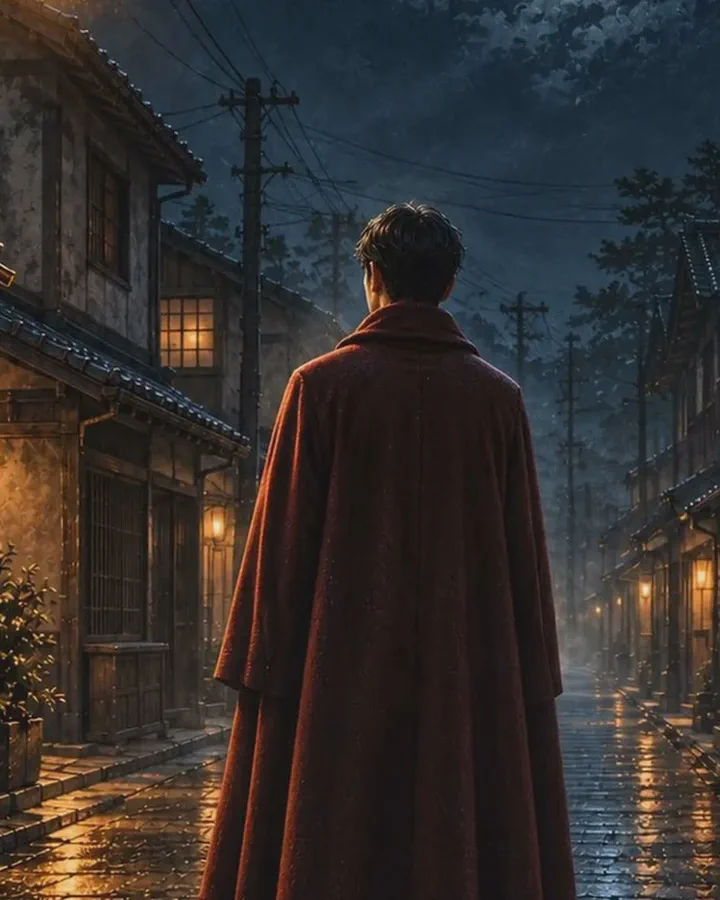
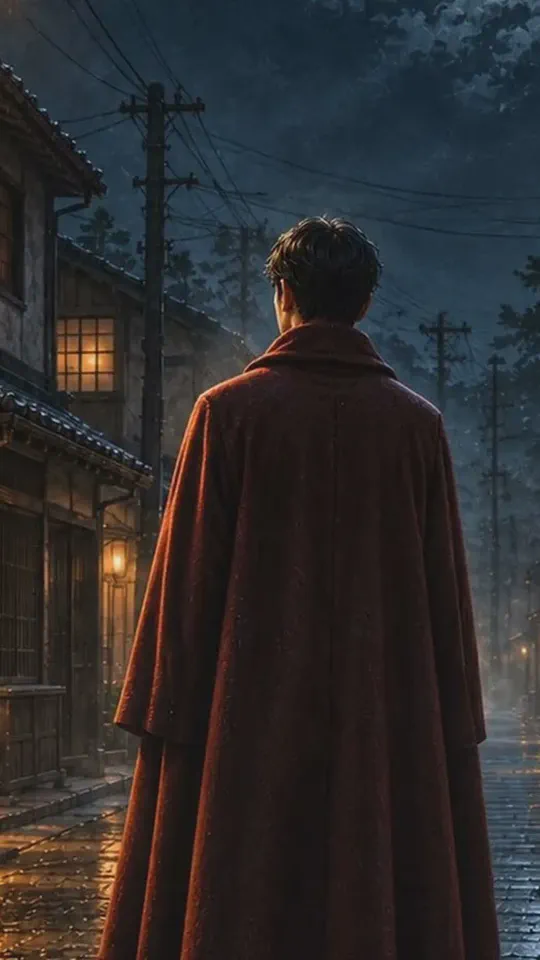
In 1939, a hunchbacked man in a red cloak, seen by no one. In the toilet stories, a voice, and then a figure in red. The games and animations of the last decade have given him a mask and a handsome face. Our illustration keeps to the 1939 street: a man in a long red cloak, seen from behind under a street lamp, who could be anyone.
Behavior and abilities
- He appears at night. To women and children walking alone, in the 1939 rumour.
- He takes blood. Or livers, or only from virgins, depending on who was telling it.
- He spreads. From Kita-Senju across the city and into the neighbouring prefectures in a month, and to Osaka by summer.
- He asks. In the toilet version, red cloak or blue, and each answer is a death.
Weaknesses and countermeasures
In 1939 the countermeasure was the radio: a police denial at seven in the evening, and a fine for repeating the story. It did not work for a month. In the toilet, the rule the children worked out is the one that applies to every such question. Do not answer. Say you want neither, or say nothing, and the voice goes away. Choose a colour and the colour is what happens to you.
Documented rumour and later imagery
Documented rumour. A rumour among Tokyo schoolchildren from about 20 February 1939 of a hunchbacked man in a red cloak who sucked the blood of women and children, denied on the radio by the Metropolitan Police on the 22nd, reported in the papers on the 23rd and 24th, and described in April by a critic as a month-long panic across the capital; an Osaka scare in July 1939 involving picture-show men; recollections, published in 1987, of a red-cloaked vampire around 1936; and the toilet tales of 1972, 1986 and 1990 in Amagasaki, Tokyo and Fujisawa.
Later imagery. The school version is the one that travelled abroad. A horror game of 2019 made him a masked pursuer in a school at night, and in January 2026 a television series about a ghost-fighting teacher put a masked man in a red cloak in front of three pupils to ask whether they liked red, blue or white. The man of 1939 asked nothing. He was never seen at all, and for a month a city of six million could talk of nothing else.
Sources and further reading
- Library Chūō Kōron 54(4), April 1939, contents (external link) National Diet Library Search Lists the essay "The sociology of the red cloak" by Ōya Sōichi on pages 422 to 427 of the 1 April 1939 issue.
- Primary text A hundred tales of crime, Shōwa edition (1988), reprinting Ōya Sōichi's 1939 essay (external link) National Diet Library Search (Chikuma Shobō) The April 1939 essay: a red-cloaked man rumoured to roam the whole capital for about a month, reaching the neighbouring prefectures, read as a protest against a press that could not be trusted.
- Reliable secondary "The red cloak" (40): Miyako Shimbun, 24 February 1939, p. 15 (external link) Sajikagen (research blog transcribing the 1939 press) Transcription of the newspaper report: the police information chief's daughters, the girls' school assembly, Kita-Senju, letters to the Ōji and Takinogawa stations, the radio denial, the penalties, and the official's guess at the picture-show origin.
- Reliable secondary "The red cloak" (324): Tokyo Asahi Shimbun, 23 February 1939, morning edition (external link) Sajikagen (research blog transcribing the 1939 press) Transcription of the column reporting the Metropolitan Police order to all precincts, the 22 February evening radio denial, and the rumour of a hunchbacked man in a red cloak sucking the blood of women and children.
- Reliable secondary "The red cloak" (113): Osaka Asahi and Osaka Mainichi, 8 July 1939 (external link) Sajikagen (research blog transcribing the 1939 press) The Osaka incident of summer 1939 involving street picture-show men, and the correction of the 1940 dating found in a later memoir.
- Fieldwork collection Gendai Minwa Kō, second series 2: School (1987) (external link) National Diet Library Search (Rippū Shobō) Recollections of a red-cloaked vampire around 1936 and 1937, and of a Nagano school where "red cloak or blue cloak" was asked.
- Academic book School Ghost Stories (Kodansha KK Bunko, November 1990) (external link) National Diet Library Search (Kodansha) The children's collection that fixed the red cloak among the school ghost stories and began the 1990s boom.
- Academic paper "Where the red cloak went", Eureka 18(7), July 1986, pp. 194–200 (external link) National Diet Library Search (Seidosha) An essay of 1986 linking the prewar rumour to the children's toilet tale.
- Reliable secondary "Casebook of real strange incidents 3: the mysterious Aka Manto" (31 July 2020) (external link) Kodansha, Gendai Media Summarises the 1987 recollections, the Nagano rules, the red-paper tale, and the origin theories (the 1936 mutiny, picture shows, an earlier cloaked man), with the author's cautions.
- Reliable secondary Aka Manto (赤マント) (external link) YOKAI.JP Used for its reference list: the Ōya Library index summary of the 1939 essay, the 1972 Amagasaki record, the 1986 Tokyo and 1990 Fujisawa collections.
- Database Aka Manto (赤マント) (external link) Wikipedia (Japanese) Catalogue of origin theories, the spread claims, and the later media; its 1940 dating follows the memoir corrected by the 1939 press.
- Reliable secondary "Hell Teacher Nūbē" episode 17, advance stills (28 January 2026) (external link) AnimeAnime A masked man in a red cloak asks three pupils whether they like red, blue or white.
- Reliable secondary Aka Manto (Chilla's Art, 2019) (external link) Steam A horror game released 23 September 2019 built on the school-toilet version.
Where it was recorded
- 1939
Kita-Senju and the city of Tokyo, Tokyo
Modern rumour
A hunchbacked man in a red cloak who sucked the blood of women and children; denied on the radio by the police on 22 February
- 1939
Osaka, Osaka
Modern rumour
The red cloak reached Osaka by July; police went after street picture-show men who had used a red-cloaked magician
- 1972
Amagasaki (a school), Hyōgo
Modern rumour
A voice in the school toilet asked, red paper or white paper; the earliest dated toilet-colour tale
- 1990
Fujisawa (a school), Kanagawa
Modern rumour
A voice in a staff toilet asked three times whether to put a red cloak on you
- undated
Toyoshina (now Azumino), Nagano
Modern rumour
A school where red cloak or blue cloak was asked, remembered from the mid-1930s in a collection of 1987
Places named in the records behind this article. Coordinates are approximate. View on the map
Related yokai
Kuchisake-onna
口裂け女(くちさけおんな)
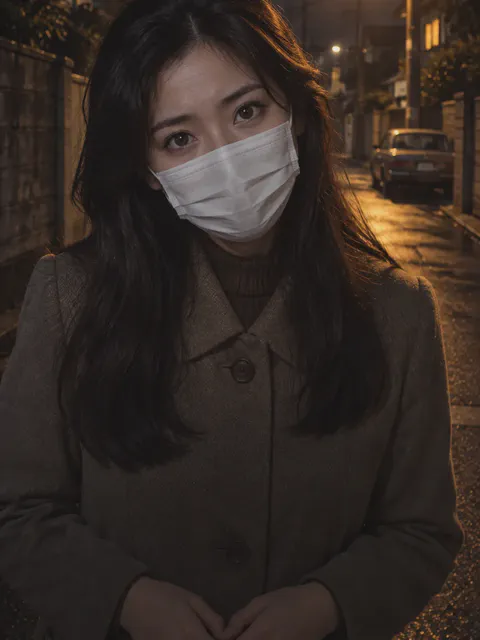
Kuchisake-onna is not an old yokai. She is a rumour that swept through Japanese schoolchildren in 1978–79: a masked woman asking 'Am I pretty?' Almost every other detail changed from school to school.
Teke Teke
テケテケ
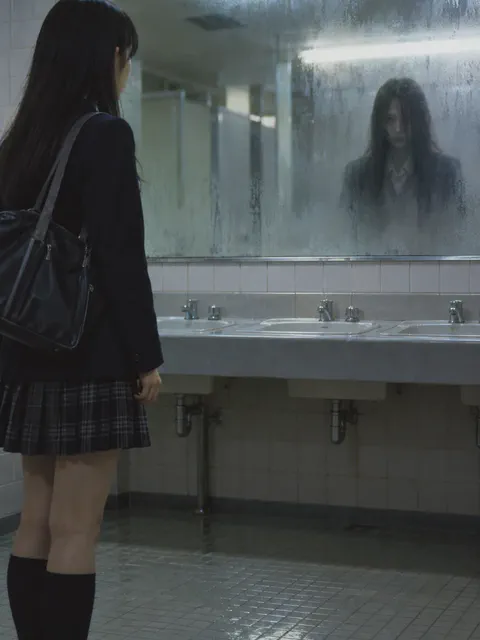
Teke Teke is a modern school ghost story, best known as the upper half of a woman who drags herself along on her elbows. Its origin cannot be traced, and one recorded version from a Kobe high school puts it in a mirror instead.
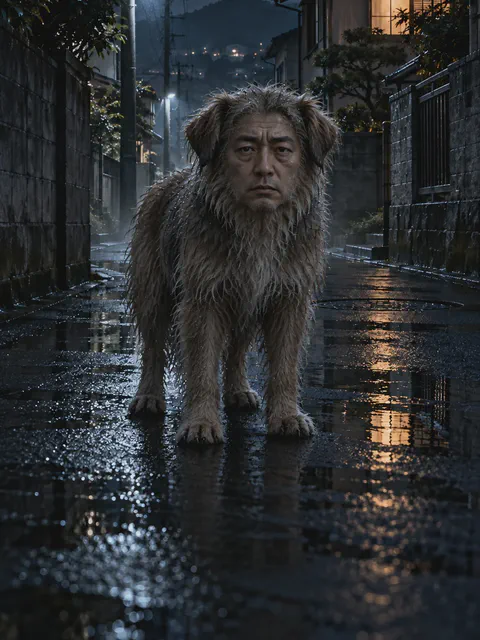
Jinmenken
人面犬(じんめんけん)
Jinmenken, the dog with a human face, swept through Japanese children's rumour around 1989–90. A first-grader in Yamagata had his own version: the dog had left Tokyo because people would not stop talking about it.