
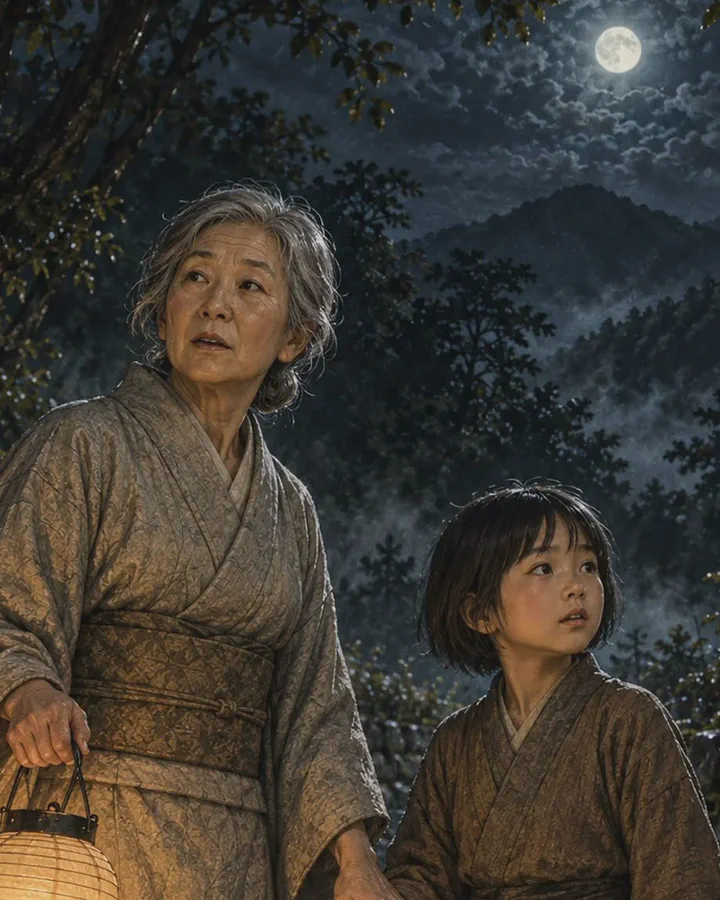
Abura-sumashi (油すまし): The Story That Answered Back
A grandmother on a mountain pass in Amakusa tells her grandchild about the thing with the oil bottle, and it answers that it still comes out: a record of 1932, the stone in the copse, and the face it was given later
油すまし(あぶらすまし) Abura-sumashi ASCII: Abura-sumashi
Also known as: Abura-zumashi, Abura-sumashi-don
Pronunciation: ah-boo-rah soo-mah-shee
Abura-sumashi (油すまし) is the thing on the Kusazumi pass in Amakusa, in Kumamoto, that answers when it is talked about. A book of 1932 gives the whole tale: an old woman crossing the pass with her grandchild by the hand said that long ago something carrying an oil bottle used to come out here, and a voice said “It still comes out”, and it came out. The book calls it the abura-zumashi, gives it no face, and stops. The old man in a straw cape with an oil jar, wise and composed, belongs to a comic strip and to two films of the 1960s.
Quick Facts
- Habitat
- Mountain, Road
- Region
- Japan, Kumamoto (Amakusa, Uki)
- Recorded period
- 1932 folklore record, modern comics and films (1960s onward)
- Nature
- Unknown
- Danger rating
The danger rating is an editorial summary made for readability. It is not an objective measure found in folklore sources.
Watch the Short
What is Abura-sumashi?
An old woman is crossing a mountain pass in Amakusa with her grandchild by the hand. The pass is the Kusazumi-goe, on the border between Kawachi in the village of Sumoto and the village of Shimoura, both now in the city of Amakusa, in the island country off the west coast of Kumamoto. On the way she remembers something, and tells the child, in the dialect of the island: here, long ago, the thing that carried an oil bottle used to come out. And a voice answers, drawing the words out: “It still comes out.” And it comes out.
That is the tale as it was printed in 1932 in a book on the folk customs of Amakusa island, written by a local folklorist, Hamada Ryūichi, and it is nearly all that was ever written down. The book spells the name abura-zumashi. It gives no description of what came out, no account of what it did next, and no word on what the grandmother and the child did either. Six years later Yanagita Kunio picked the tale up for his running glossary of yokai names in a folklore journal, called the thing “a monster of that name”, and was as silent about its looks as the book had been.
What does abura-sumashi mean?
Abura is oil. Sumashi is the puzzle. Yanagita left it unexplained. Modern books often read it as sumashi-gao, a composed, deadpan face, but that reading describes the picture drawn in the twentieth century rather than anything in the 1932 tale. On the island itself the name is said abura-sumashi, not -zumashi, and the local verb for pressing oil was sumeru, which has led people in Kawachi to think of an oil-presser. Camellia and sasanqua seeds were pressed for katashi oil all over Amakusa, and Kawachi was known for it.
There is a stranger reading. The grandmother’s words say only that “the one that hung an oil bottle” came out, and sageta, to hang something, can mean to dangle it from above. Yanagita listed the abura-sumashi beside the tsurube-otoshi, the yakan-zuru and the sagari, all of them things that come down out of trees or rafters, which has led the novelist and yokai scholar Kyōgoku Natsuhiko to wonder whether the abura-sumashi was never a figure walking the pass at all, but an oil bottle hanging down from above it. He looked, and could not prove it.
Other things that answer
The 1932 book has a second pass with the same habit. At Masuda, in the village of Icchōda, now also part of Amakusa, two people walking together over the Uso pass recalled that a bloody human hand once fell here. “Now too,” said a voice, and a hand rolled down the slope. They ran, and when they had got clear one of them said that a severed head once fell here as well. “Now … too,” said the voice, and a head came rolling down.
On the mainland, at Shimogō Obata in the village of Toyono, now in the city of Uki, there was a slope called Ima-ni-mo, “any moment now”, where a giant monk appeared; two people walking up it talking about him heard “any moment now” and there he was. In all three tales the monster is not the subject of the story but its last line. Someone tells it, and it answers.
The stone in the copse
Above the hamlet of Kawachi, ten metres up a scrubby slope from the lane where the houses end, stands a stone figure with no head, its hands pressed together like a Jizō. The neighbourhood calls it Abura-sumashi-don, the honourable abura-sumashi, and keeps it. It stood once by a path called the Suberimichi, the slide path, at Nakanokado, and was moved up into the copse when the road was widened; the old gravestones beside it are dated to the Tenmei and Bunsei eras, between 1781 and 1830. Children who played on the slide path were told that Abura-sumashi-don would come out. Those were famine years in Amakusa, when oil was precious, and the people who keep the stone read it as the god of oil, or an oil-presser honoured after death who turned into a monster as the centuries passed. The grandmother on the pass knew nothing of a stone; the stone’s keepers know nothing of a bottle.
Appearance
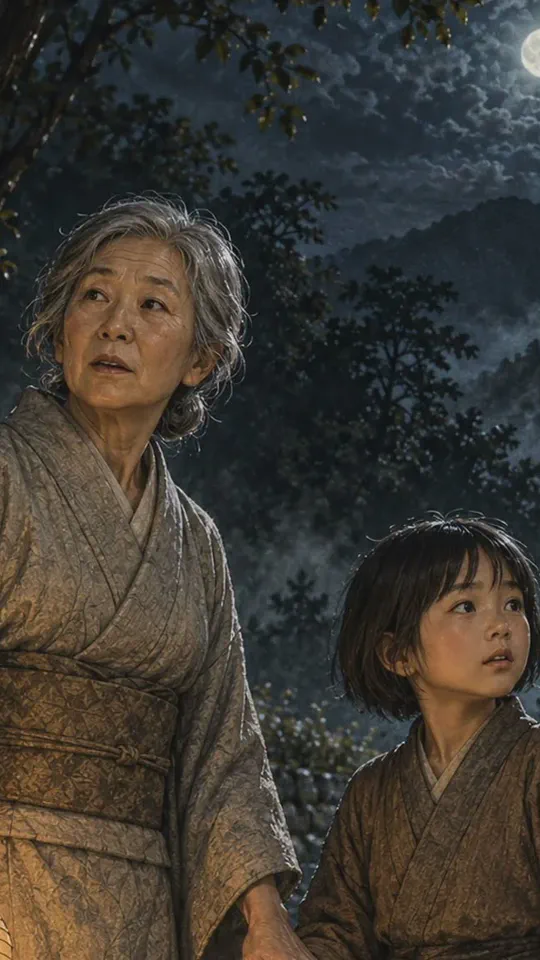
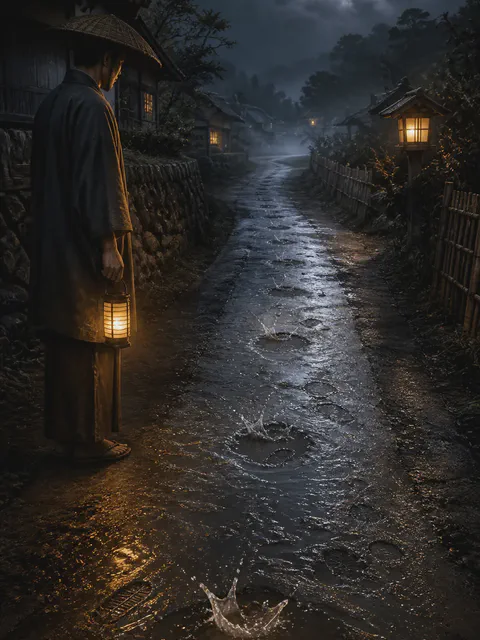
None in 1932, none in 1938. Our illustration keeps to what the tale contains: the pass at night, a stone wall, a grandmother and a child with a lantern, and the two of them turning toward a voice from beyond the edge of the picture. The bottle appears on its own, a brown stoneware flask with a cord, drawn as a prop and not found on the road.
The face everyone knows is forty years younger than the tale. In the 1960s a comic-strip artist drew the abura-sumashi as an old man in a straw rain cape with an enormous head, and two monster films of 1968 put that figure on screen, where it served as the strategist among the monsters; from there it passed into the yokai books, which call it wise and deadpan and sometimes explain it as the ghost of an oil thief. A 1997 dictionary of fantastic animals gives the whole modern package in three lines. The cape, the big head, the composure and the thief are all from the drawing.
Behavior and abilities
- It answers. “It still comes out”, in a drawn-out voice, when the story is told on the pass.
- It comes out. Once the story has been finished for it.
- It carried an oil bottle. Long ago, the grandmother said; whether in its hand or hanging from above is the open question.
Weaknesses and countermeasures
None are recorded. The only rule the three Kumamoto tales imply is the one their tellers broke: do not tell the story on the spot. The grandmother told it, the two travellers told it twice, the walkers on the Ima-ni-mo slope told it, and each time the ending arrived on its own.
Documented tradition and later imagery
Documented tradition. The grandmother and grandchild on the Kusazumi pass between Kawachi and Shimoura, the oil bottle and the answer, printed in 1932 and glossed in 1938; the hand and the head of the Uso pass at Masuda in the same book; the giant monk of the Ima-ni-mo slope at Toyono; and the headless stone called Abura-sumashi-don in the copse above Kawachi.
Later imagery. The old man in the straw cape with the oil jar and the great bald head, from the comic strip and the 1968 films; the strategist, the deadpan sage, the thief’s ghost, and the bronze on the yokai street in Sakaiminato with its own rustling in the bushes. The 1932 tale is quieter. A story was being finished, and something on the pass finished it.
Sources and further reading
- Museum The abura-sumashi of Kusazumi-goe (Kawachi, Sumoto, Amakusa) (external link) Kumamoto Prefectural Museum Network Retells the tale from Hamada Ryūichi's 1932 book in the island dialect: the grandmother and grandchild on the Kusazumi pass between Kawachi and Shimoura, the oil bottle, the answer "it still comes out". Also the headless stone figure in the copse above Kawachi, the nearby graves of the Tenmei and Bunsei eras, and the local pressing of katashi oil.
- Library Amakusa-tō Minzokushi (天草島民俗誌), Hamada Ryūichi, Kyōdo Kenkyūsha, 1932 (external link) National Diet Library Search Catalogue record of the 1932 book on the folk customs of Amakusa island that first printed the tale.
- Reliable secondary Draw the Amakusa yokai abura-sumashi (2023) (external link) Amakusa City The stone figure in Kawachi kept by the neighbourhood as the abura-sumashi's grave, the old woman's tale, the open question of what the thing was, and the straw-caped, big-headed old man of comics and films as a separate image.
- Database Abura-sumashi (油すまし) (external link) Wikipedia (Japanese) The 1932 wording and the abura-zumashi spelling, Yanagita's "monster of that name", the hanging-bottle reading, the Uso pass hand and head, the Ima-ni-mo slope at Toyono, the Abura-sumashi-don stone, the oil-presser etymology, and the comic-strip and 1968 film origin of the straw-caped figure.
- Reliable secondary Yokai that lurk close to home: the bronze statues of Mizuki Shigeru Road (external link) Mizuki Shigeru Museum, Sakaiminato Statue 120, uwan, placed in Aomori as a loud voice in front of an old house with no visible body; statue 131, abura-sumashi, placed in Amakusa with the grandmother's story and a rustling in the bushes. Consulted for the later image only.
Where it was recorded
- 1932
Kusazumi pass, between Kawachi in Sumoto and Shimoura (now Amakusa), Kumamoto
Folklore record
A grandmother tells her grandchild that something with an oil bottle used to come out here; a voice answers that it still comes out, and it does
- 1932
Masuda, Icchōda (now Amakusa), Kumamoto
Folklore record
On the Uso pass two travellers recall a bloody hand that once fell here; a voice says it still does, and a hand rolls down the slope, then a head
- 1950
Shimogō Obata, Toyono (now Uki), Kumamoto
Folklore record
On the slope called Ima-ni-mo, talk of the giant monk brings the answer 'any moment now' and the monk himself
- undated
Kawachi, Sumoto (now Amakusa), Kumamoto
Living rite
A headless stone figure with its hands together, called Abura-sumashi-don, kept in a copse above the hamlet and honoured by the neighbourhood
Places named in the records behind this article. Coordinates are approximate. View on the map
Records behind this article
Related yokai
Yamawaro
山童(やまわろ)
The hairy mountain child of Kyushu: a 1950 Ashikita record of one snapping twigs all night beside a charcoal burner, the rice balls and sake it works for, the paths where no kiln may stand, and the belief that it is the kappa gone up the mountain for the winter.
Chabukuro
茶袋(ちゃぶくろ)
A tea-steeping bag that hangs in the air on eerie stretches of road in the Hata district of Kōchi, recorded in 1938, with illness blamed on anyone it strikes; related bags hang from trees in Kagawa and float on rivers in Wakayama.
Betobeto-san
べとべとさん(べとべとさん)
On a night road in Uda you hear a bita-bita footfall coming along behind you. There is nobody there. Step aside, say the words, and it stops — which is the entire record.