
水木しげるロード · Street · Sakaiminato, Tottori
Mizuki Shigeru Road
Eight hundred metres of bronze yokai from the station to the museum, in the port town where the artist grew up.
Quick Facts
- Type
- Street
- Prefecture
- Tottori · Sakaiminato
- Nearest station
- Sakaiminato Station (JR Sakai Line)
- From the station
- The road begins at the station forecourt and runs east for about 800 m
- English signage
- some
- Opening hours and admission
- See the official site (external link) · information checked on 2026-11-03
Hours, admission and closing days change, and this site does not list them. The link goes to the place's own page, with the date we last checked it.
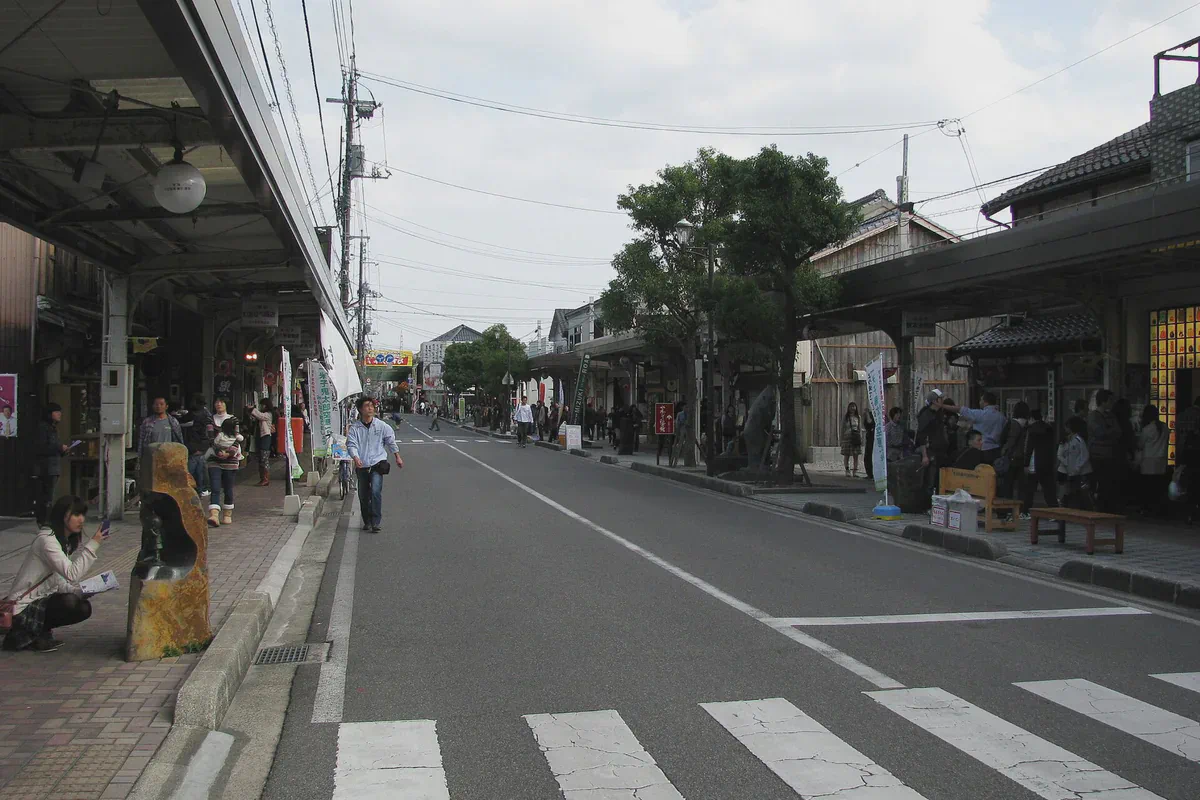
What is there
The road runs east from Sakaiminato station for about eight hundred metres and is lined on both sides with bronze statues of the yokai Mizuki Shigeru drew. It opened in 1993 with twenty-three of them and has been added to ever since; after the rebuilding of 2018 there are more than a hundred and seventy, each with a nameplate, lit at night. Shops sell the yokai in every form, the trains on the branch line are painted with the characters, and partway along stands the Yōkai Shrine, founded in 2000, with a wheel of water for the eyeball father. The memorial museum is at the far end.Why here
Most of the yokai on this road were words before they were pictures. The wall that blocks a night road was recorded in Fukuoka in 1938 without a face; the bolt of cotton that flies in Kagoshima and the old man who cries in the Tokushima mountains were recorded the same year. Mizuki, who grew up in this town, gave them the faces the whole country now knows, and set beside them the creatures of the Edo picture scrolls. The road is the record of that work, in bronze, with the recorded yokai and the drawn ones standing side by side.Yokai you will meet
- Nurikabe 塗り壁 — The wall recorded on an Onga road in 1938, given a face here.
- Ittan-momen 一反木綿 — The flying bolt of cotton of the Kagoshima records, in bronze.
- Konaki-jiji 児啼爺 — The crying old man of the Tokushima mountains.
- Nurarihyon 滑瓢 — The slippery old gentleman of the Edo scrolls, as Mizuki drew him.
- Azuki-arai 小豆洗い — The bean-washer at his stream.
- Betobeto-san べとべとさん — The following footsteps, given a grinning face.
- Kappa 河童 — The river child among the statues.
- Tengu 天狗 — The mountain creature of the tales among the statues.
In manga: GeGeGe no Kitarō
Getting there
Sakaiminato Station (JR Sakai Line). The road begins at the station forecourt and runs east for about 800 m.
Sources and further reading
- Reliable secondary Sakaiminato Tourism Association (external link) Sakaiminato Tourism Association Official visitor site for the road, the shrine and the museum; states that the statues and characters are the property of Mizuki Productions.
- Reliable secondary Mizuki Shigeru Road: a guide (external link) Sakaiminato Tourism Association The association's 2024 feature on walking the road and its statues.
- Database Mizuki Shigeru Road (水木しげるロード) (external link) Wikipedia (Japanese) Opened 1993 with 23 statues, the 2018 renewal, the Yōkai Shrine of 2000 and the painted trains.
Other places with these yokai
- Mizuki Shigeru Memorial Museum 水木しげる記念館 Museum
- Kitarō Chaya 鬼太郎茶屋 Shop
- Tōno Municipal Museum 遠野市立博物館 Museum
- Tōno Folktale Museum とおの物語の館 Museum
- Fukusaki: Yanagita Kunio's Birthplace and the Yokai Benches 福崎町(柳田國男・松岡家記念館と妖怪ベンチ) Site
- Yokai Yashiki at Ōboke 妖怪屋敷と石の博物館(道の駅大歩危) Museum
- Kappa-buchi and Jōkenji カッパ淵と常堅寺 Site
- Denshōen 伝承園 Museum
- Kashōzan Mirokuji 迦葉山弥勒寺 Shrine or temple
- Takaosan Yakuōin 高尾山薬王院 Shrine or temple
- Daiyūzan Saijōji 大雄山最乗寺 Shrine or temple
- Kurama-dera 鞍馬寺 Shrine or temple
- The Konaki-jiji Statue at Fujikawa Valley 児啼爺の碑(藤川谷) Site
- Yokai Art Museum, Shōdoshima 妖怪美術館(小豆島) Museum
- Tanushimaru Station, the Kappa Station 田主丸駅(河童駅舎) Site
- Kurume Suitengū 久留米水天宮(全国総本宮) Shrine or temple
- The Kappa Landing Stone at Yatsushiro 河童渡来之碑(徳渕の津) Site
Other places in Tottori
- Mizuki Shigeru Memorial Museum 水木しげる記念館 Museum