
伝承と後世の表現
Documented tradition and later imagery
The distinction every article on this site is built around.
Each yokai article ends with a section under this heading, and the two halves mean different things. Documented tradition is what can be placed: a record with a district and a year, a dated scroll or print, a text with a title. The kappa of Kikuchi that fills its dish before leaving the water, in a journal of 1913; the umbrella dancer printed in Osaka in 1857; the snow woman of a hunter’s tale from Miyagi. Later imagery is everything that came after and now stands in front of the record: the green cartoon kappa, the nurikabe with eyes, the giant skeleton invented in 1966 and matched afterwards to a print of the 1840s.
Neither half is more real than the other; a yokai that exists only as a picture is still a yokai. The point is to say which is which, so that a reader knows when a detail is three centuries old and when it is thirty years old.
Related yokai
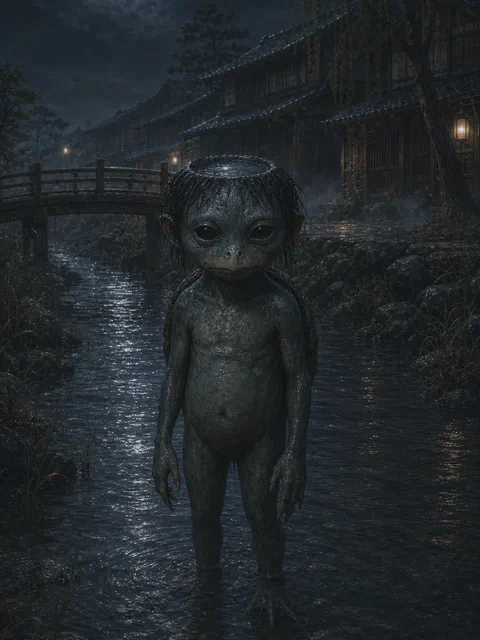
Kappa
河童(かっぱ)
A child-sized water yokai whose strength lives in the water held by the dish on its head.
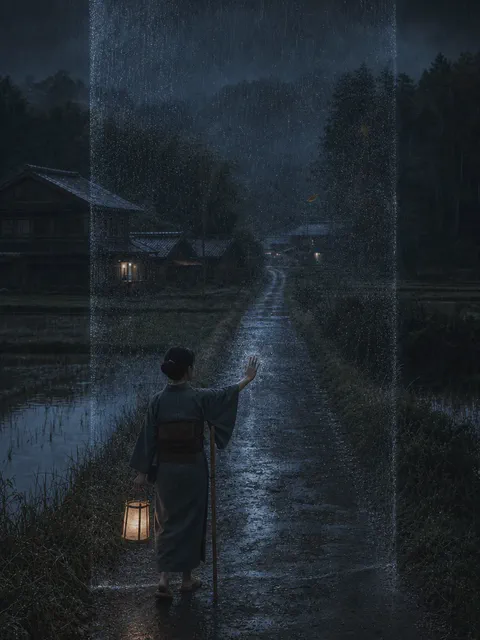
Nurikabe
塗り壁(ぬりかべ)
A night-road obstruction that stops travelers like a wall, though the early record does not describe a visible body.
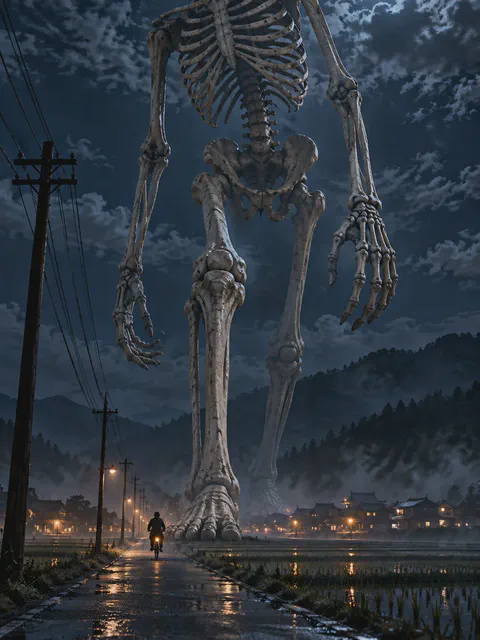
Gashadokuro
がしゃどくろ
Gashadokuro, the giant skeleton, looks ancient. It was created by the writer Saitō Morihiro in 1966, taken into Mizuki Shigeru's yokai collection in 1968, and later matched to a Kuniyoshi print from the 1840s that never used the name.
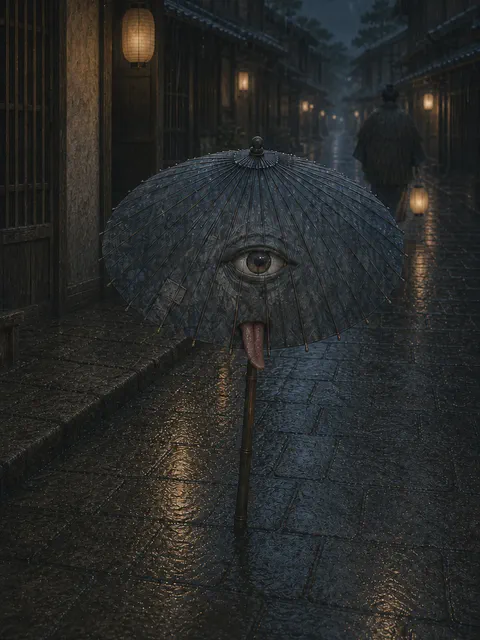
Karakasa-kozō
唐傘小僧(からかさこぞう)
An 1857 Osaka print shows a kabuki actor playing a one-legged umbrella monster — the clearest history of a yokai known through pictures rather than encounters.